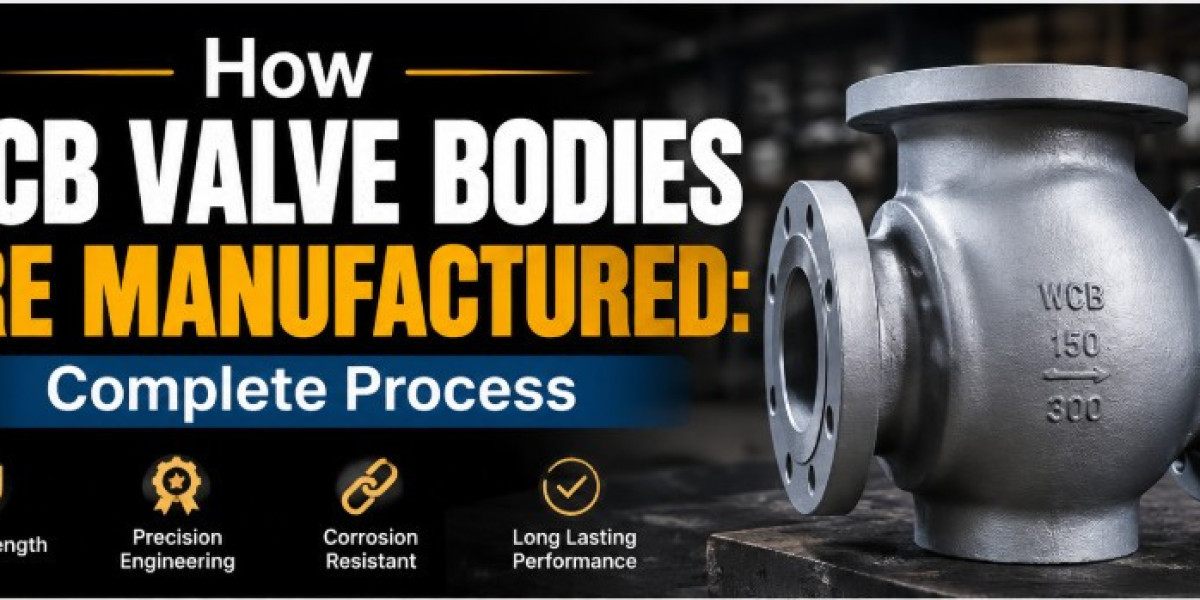

Industrial valves play a critical role in controlling the flow of liquids, gases, and steam across various industries. At the center of every valve is the valve body — the main pressure-containing component responsible for strength, durability, and reliable operation. Among different material grades used for valve manufacturing, WCB valve bodies are widely chosen due to their mechanical strength and suitability for medium- to high-pressure industrial applications.
Understanding how a WCB valve body is manufactured helps buyers, engineers, and procurement teams evaluate quality standards and select reliable components for demanding environments. From raw material preparation to final inspection, every stage influences the performance and lifespan of the finished product.
What Is a WCB Valve Body?
WCB refers to ASTM A216 Grade WCB, a cast carbon steel material commonly used for valve bodies and pressure-containing components. It offers excellent strength, good machinability, and the ability to perform effectively under varying temperature and pressure conditions.
WCB material is widely used in industries such as:
Oil and gas
Power generation
Chemical processing
Petrochemical plants
Water treatment systems
Industrial manufacturing facilities
The manufacturing process requires precision and strict quality control to ensure the finished valve body meets industry standards.
Step 1: Raw Material Selection
The manufacturing process begins with selecting suitable raw materials. High-quality carbon steel, scrap metal, ferroalloys, and other required elements are carefully chosen based on material specifications.
Material composition directly affects:
Mechanical strength
Hardness
Weldability
Pressure resistance
Durability
Manufacturers typically perform chemical composition testing before melting to ensure compliance with industry standards.
Step 2: Pattern Making
Pattern making is one of the most important stages in valve body production. A pattern acts as the replica of the final valve body shape and is used to create the mold cavity.
Patterns can be produced using:
Wood
Metal
Plastic
CNC-machined materials
Proper pattern design is critical because even small inaccuracies can affect dimensions and create defects in the finished component.
Modern foundries often use CAD software and CNC technology to improve accuracy and maintain consistency.
Step 3: Mold Preparation
Once the pattern is ready, the mold is prepared using suitable molding materials, commonly sand mixtures.
The mold cavity is formed around the pattern and designed to accommodate:
Molten metal flow
Shrinkage allowance
Ventilation
Solidification behavior
A properly designed mold helps minimize defects such as shrinkage, porosity, and cracks.
At this stage, cores may also be inserted to create internal passages and cavities within the valve body.
Step 4: Melting and Pouring of Steel
After mold preparation, the selected raw materials are melted inside industrial furnaces.
Common furnace types include:
Electric arc furnaces
Induction furnaces
Cupola furnaces
The metal is heated to extremely high temperatures until it reaches a molten state. During this process, manufacturers continuously monitor temperature and chemical composition.
Once the molten steel achieves the required properties, it is carefully poured into the prepared mold cavity.
Precise pouring is essential because improper pouring conditions can create internal defects and affect product quality.
Step 5: Cooling and Solidification
After pouring, the molten steel begins to cool and solidify inside the mold.
Cooling rates significantly influence:
Grain structure
Mechanical properties
Internal stress levels
Surface quality
Controlled cooling helps improve the overall integrity of the valve body and reduces the possibility of manufacturing defects.
After sufficient cooling, the casting is removed from the mold through a process known as shakeout.
Step 6: Fettling and Cleaning
The rough casting obtained after shakeout usually contains excess material, gates, risers, and surface impurities.
These unwanted portions are removed through cleaning operations such as:
Grinding
Shot blasting
Cutting
Surface finishing
This stage improves appearance and prepares the casting for further processing.
Step 7: Heat Treatment Process