
Accurate drywall estimating is one of the most important skills a contractor can develop. Whether you’re bidding on residential renovations, commercial build-outs, or large-scale developments, your profitability depends on precise quantity takeoffs and labor projections. Even small calculation errors can lead to material shortages, cost overruns, or lost bids.In this guide, we’ll break down the essential drywall estimating formulas every contractor should know, along with practical examples you can apply immediately to your projects.
Drywall Sheet Calculation Formula
The foundation of any drywall estimate begins with calculating the number of sheets required.
Formula.
Total Wall Area ÷ Area of One Drywall Sheet = Number of Sheets Required
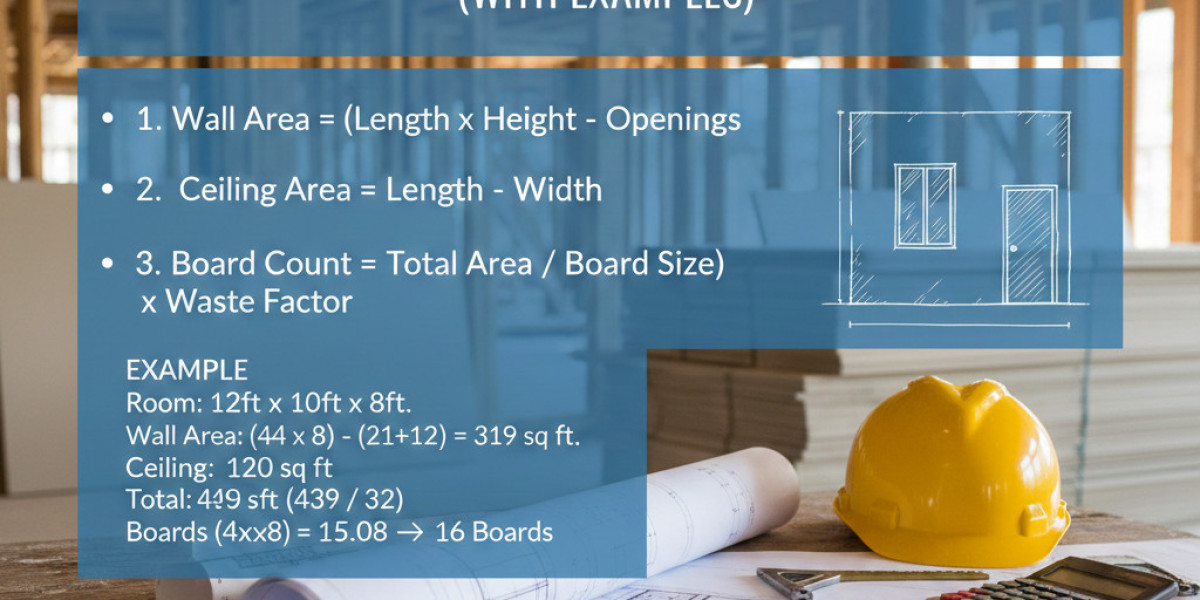
Step 1: Calculate Wall Area
Wall Area = Length × Height
If you’re working with multiple walls, calculate each separately and add them together.
Example:
Room dimensions: 12 ft × 10 ft
Wall height: 8 ft
Perimeter = (12 + 10 + 12 + 10) = 44 ft
Wall Area = 44 × 8 = 352 sq ft
If using standard 4 ft × 8 ft drywall sheets:
Sheet Area = 4 × 8 = 32 sq ft
Sheets Needed = 352 ÷ 32 = 11 sheets
Always round up to account for cuts and waste.
Ceiling Drywall Calculation
Ceilings require a separate area calculation.
Formula:
Ceiling Area = Length × Width
Example:
For a 12 ft × 10 ft room:
Ceiling Area = 12 × 10 = 120 sq ft
Sheets Needed = 120 ÷ 32 = 3.75
Round up to 4 sheets.
Waste Factor Formula
No drywall job is completed without material waste due to offcuts, mistakes, or irregular layouts.
Standard Waste Percentage
Residential projects: 5%–10%
Commercial projects: 10%–15%
Formula
Total Sheets × Waste Percentage = Additional Sheets Required
Example
If your project requires 15 sheets:
Waste (10%) = 15 × 0.10 = 1.5 sheets
Round up to 2 additional sheets.
Total order: 17 sheets.
Labor Cost Estimation Formula
Labor often represents a large portion of drywall project costs.
Basic Formula
Total Square Footage ÷ Production Rate = Labor Hours
Average Production Rates
Hanging drywall: 40–60 sheets per day (crew dependent)
Finishing drywall: 800–1,000 sq ft per day
Example:
Total Area = 1,200 sq ft
Production Rate = 900 sq ft per day
Days Required = 1,200 ÷ 900 = 1.33 days
Multiply by crew size and hourly rate for total labor cost.
Drywall Screws Estimation Formula
Underestimating fasteners can delay a job.
Industry Rule of Thumb
1 pound of screws per 100 sq ft
Approximately 30–40 screws per 4×8 sheet
Formula:
Total Sheets × Screws Per Sheet
Example:
20 sheets × 35 screws = 700 screws
Add 5–10% buffer for safety.
Joint Compound (Mud) Estimation Formula
Joint compound usage depends on finish level.
Average Coverage:
1 gallon per 100–150 sq ft (Level 4 finish)
Formula:
Total Square Footage ÷ Coverage Rate
Example:
1,000 sq ft project
Coverage Rate: 125 sq ft per gallon
1,000 ÷ 125 = 8 gallons
Adjust upward for higher finish levels.
Drywall Tape Calculation
Tape is typically estimated based on linear feet of joints.
Basic Estimation:
One 4×8 sheet requires about 20–25 linear feet of tape
Formula:
Number of Sheets × Average Tape Length
Example:
15 sheets × 22 ft = 330 linear feet
Purchase rolls accordingly.
Corner Bead Estimation Formula
Corner beads are required for exposed outside corners.
Formula:
Number of Outside Corners × Wall Height
Example:
If you have 6 outside corners in an 8 ft high room:
6 × 8 = 48 linear feet
Always add 5% extra for cutting waste.
Cost Per Square Foot Formula
Many contractors price drywall jobs by square footage.
Formula:
Total Project Cost ÷ Total Square Footage
Example:
Total cost: $3,600
Total area: 1,200 sq ft
Cost per sq ft = $3.00
This metric helps compare project profitability and improve bidding accuracy.
1Markup Formula for Profit
Estimating isn’t just about costs, it's about profit.
Formula:
Total Cost × Markup Percentage = Selling Price
Example:
Project cost = $5,000
Markup = 20%
Selling Price = 5,000 × 1.20 = $6,000
Never confuse markup with margin; this is a common mistake among contractors.
Productivity Adjustment Formula
Different project conditions affect production:
High ceilings
Tight spaces
Complex layouts
Multi-story buildings
Formula:
Base Labor Hours × Difficulty Factor
If a job is 20% more complex:
Labor Hours × 1.20
Example:
Base labor = 40 hours
Adjusted = 40 × 1.20 = 48 hours
This prevents underbidding complex jobs.
Comprehensive Example: Full Room Estimate
Let’s combine everything.
Room: 15 ft × 12 ft × 9 ft height
Step 1: Wall Area
Perimeter = (15 + 12 + 15 + 12) = 54 ft
Wall Area = 54 × 9 = 486 sq ft
Step 2: Ceiling Area
15 × 12 = 180 sq ft
Step 3: Total Area
486 + 180 = 666 sq ft
Step 4: Sheets Required
666 ÷ 32 = 20.8 sheets
Round up = 21 sheets
Add 10% waste:
21 × 0.10 = 2.1 → 3 sheets
Total = 24 sheets
Step 5: Screws
24 × 35 = 840 screws
Step 6: Joint Compound
666 ÷ 125 = 5.3 gallons
Round up = 6 gallons
This systematic approach ensures accuracy and confidence when submitting bids.
Why Mastering Drywall Estimating Formulas Matters
Contractors who rely on guesswork often face.
Budget overruns
Material shortages
Reduced profit margins
Lost competitive bids
Accurate drywall estimating allows you to.
Improve bid confidence
Reduce waste
Increase profitability
Streamline project management
Professional takeoff services like Universe Estimating help contractors scale operations by providing detailed quantity takeoffs and cost analysis, ensuring every formula is applied correctly.
Pro Tips for Better Drywall Estimates
Always verify field measurements twice.
Separate walls and ceilings in calculations.
Include doors and window deductions only if significant.
Factor in ceiling height changes.
Track historical job data for improved accuracy.
Adjust production rates based on crew experience.
Include delivery and equipment costs.
The more data you collect from completed projects, the more precise your future estimates will become.
Final Thoughts
Drywall estimating is both a science and an art. The science lies in understanding and applying the right formulas from sheet count calculations to labor productivity adjustments. The art comes from experience, job condition awareness, and market knowledge.By mastering these essential drywall estimating formulas, contractors can submit competitive bids while protecting profit margins. Whether you’re handling small residential jobs or large commercial builds, accurate calculations will always be your strongest competitive advantage.Use these formulas consistently, refine them with real project data, and you’ll build a reputation for precision and reliability in every bid you submit.