

Most coaches treat scoring and stats as separate tasks. Someone keeps the score, and if the team is organized, someone else records stats. Afterwards, the two records rarely come together. That means coaches know the final score and maybe a few numbers, but not how they connect. What happens when you bring scoring and stats together? In this article we look at how connecting the score to your match analysis gives coaches a much clearer understanding of why points were won and lost, and how that insight shapes better practices and lineups.
Why the Score Alone Isn't Enough
The final score tells you who won, but not why. A 25 to 22 set could result from a strong serving run, a weak rotation or a series of attack errors. Without more context, it's hard to know what to work on. Even the sequence of points only tells part of the story. You might see that the opponent scored five in a row, but not what caused the run. Connecting the score to stats and rotations fills in those gaps, turning a simple scoreline into a detailed picture of how the match actually unfolded. A long run of points is often the turning point of a set, and the reasons behind it are exactly what coaches most want to understand afterwards.
Linking Points to Rotations
When scoring is connected to your lineup, every point is linked to the rotation your team was in. Koach Volleyball makes this connection automatically, so after the match you can see which rotations won the most points and which lost the most. This often reveals patterns that are hard to notice during play. Maybe your team struggles when a certain setter is in the front row or when a particular passer is exposed in serve receive. Knowing this allows you to adjust lineups or focus practice on specific rotations, addressing weaknesses that might otherwise remain hidden.
Adding Stats to the Picture
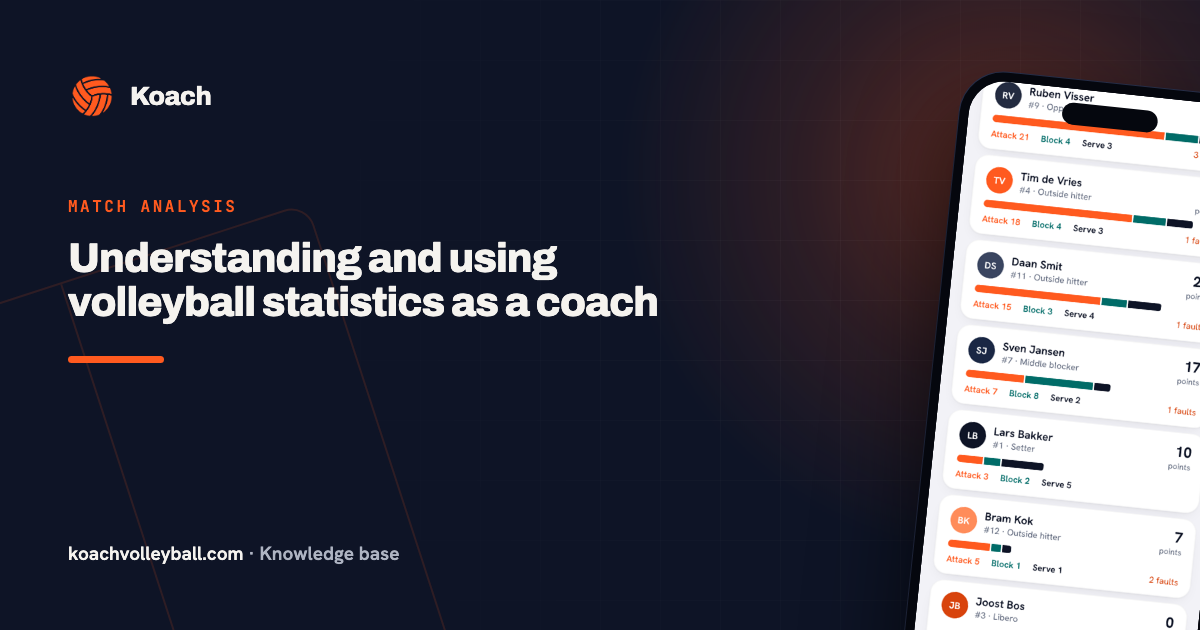
When stats are recorded alongside the score, you can see not just when points were lost but how. Were they serve errors, attack errors or opponent kills? Did passing break down in certain rotations? Combining these details with the score shows you the real story behind each set. For example, you might discover that most points lost in a tight set came from serve receive errors in one rotation. That's a clear, actionable insight. Without the connection between scoring and stats, you'd have to piece this together manually, if you could do it at all.
Using Connected Data During Matches
Connected scoring and stats aren't just useful after the match. During timeouts and between sets, you can check which rotations are struggling and what types of errors are costing points. This helps you make targeted adjustments, such as changing the starting rotation, making a substitution or reminding servers to reduce errors. Quick, informed decisions can turn a set around. Rather than relying on general impressions, you have clear evidence to guide your coaching. This is especially valuable in close matches, where small adjustments often make the difference between winning and losing.
Turning Analysis into Improvement
The ultimate goal of match analysis is improvement. When scoring and stats are connected, your analysis becomes clearer and more actionable. You can plan practices that target specific rotations or skills, adjust lineups to protect weaker areas and track whether changes lead to better results over time. Over a season, this approach helps teams improve steadily and coaches make more confident decisions. Bringing the score and stats together in one place transforms routine match records into a powerful coaching resource that supports better preparation, smarter decisions and consistent player development.