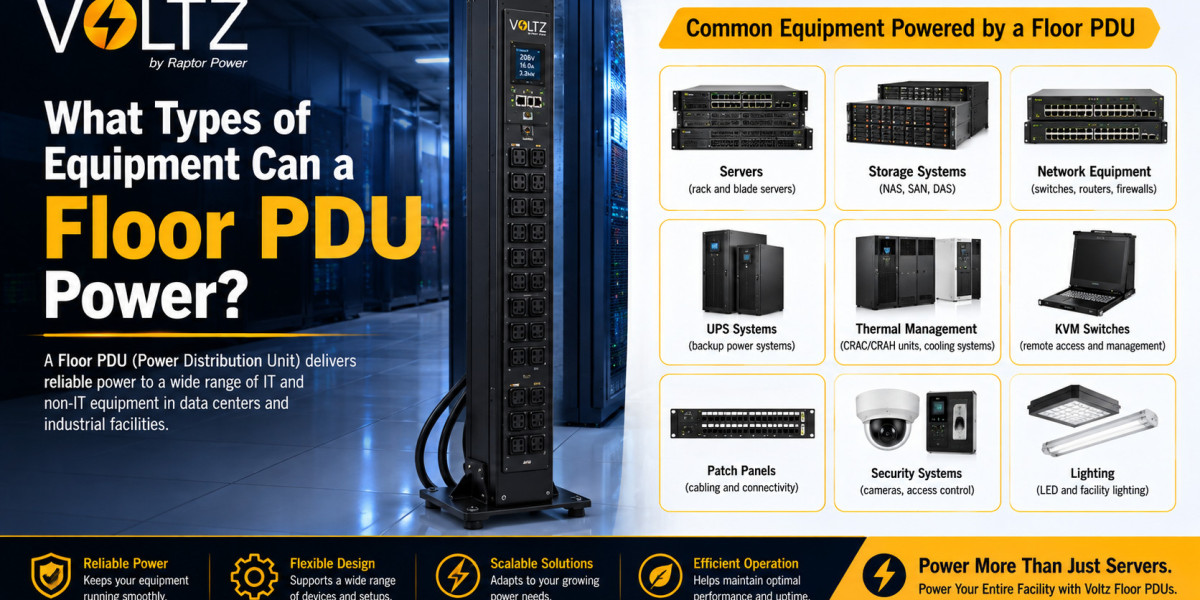

Setting up a data center or scaling an enterprise server room involves numerous architectural decisions. While rack-level components often receive the most attention, the underlying electrical distribution architecture makes high-density operations possible. At the core of this electrical distribution sits the Floor PDU (Power Distribution Unit).
Unlike smaller rack-mounted strip units that sit directly inside an equipment cabinet, a Floor PDU serves as the main electrical transformer and distribution hub for an entire row or room of equipment racks. It takes raw high-voltage electricity coming from a building utility transformer or Uninterruptible Power Supply (UPS) system and safely steps it down, transforms it, and distributes it across multiple downstream circuits.
Understanding what types of equipment a Floor PDU powers helps facility managers, network engineers, and IT directors build a resilient, scalable, and safe infrastructure.
What Is a Floor PDU and How Does It Work?
Before diving into the specific machinery powered by a Floor PDU, it helps to understand its place in the power chain.
A Floor PDU is a standalone, heavy-duty electrical cabinet installed directly on the raised floor or concrete slab of a data center. Think of it as an industrial-grade, highly intelligent circuit breaker panel combined with a isolation transformer.
The Electrical Journey: From Utility to Chip
Upstream Source: High-voltage AC power originates from the primary electrical grid or facility back-up generators and passes through a central double-conversion UPS system.
The Floor PDU Level: The high-voltage power enters the Floor PDU. Here, an internal transformer steps down high voltage (such as 480V 3-phase in North America or 400V 3-phase globally) into lower, usable distribution voltages (such as 208V/120V or 230V).
Sub-Feeding Circuits: The internal panelboards, breakers, or sub-feed switches inside the Floor PDU break this massive power capacity into dozens or hundreds of individual branch circuits.
Downstream Delivery: These branch circuits run via overhead cable trays or under-floor conduit whips directly to rack-mount PDUs, floor-standing machinery, and specialized cooling equipment.
By providing electrical isolation, voltage step-down, and localized circuit protection, the Floor PDU serves as a critical buffer between heavy incoming building power and sensitive IT microprocessors.
1. Primary Rack-Level Power Infrastructure (Rack PDUs & Busways)
A Floor PDU rarely plugs directly into an individual server blade. Instead, its primary direct load consists of rack-level power distribution architectures that distribute power down to the individual device level.
Rack Power Distribution Units (rPDUs)
The most common equipment connected downstream from a Floor PDU is a network of Rack PDUs (rPDUs). Installed vertically (0U) or horizontally (1U/2U) inside individual server cabinets, rPDUs receive 208V or 400V feed lines directly from the Floor PDU branch circuits.
Basic rPDUs: Standard power strips that feed raw current to server power supplies.
Smart / Metered rPDUs: Intelligent power strips that track current draw per outlet or per phase, sending telemetry back to Data Center Infrastructure Management (DCIM) software.
Switched rPDUs: Allow engineers to remotely turn individual outlets on or off to reboot frozen servers.
Overhead Track Busway Systems
Modern modular data centers often replace traditional sub-floor whip cables with overhead track busways. In this arrangement, the Floor PDU feeds a high-amp overhead busway run. Tap-off boxes then plug into the busline at any point above a server rack to drop flexible power whips down to the cabinet, eliminating messy under-floor cable bundles.
2. High-Density Compute and Storage Infrastructure
Modern data centers host dense computing clusters that require clean, continuous, and regulated electrical current. The Floor PDU feeds the main power lines that energize these heavy-duty hardware systems.
Enterprise Rack & Blade Servers
High-density 1U, 2U, and blade server chassis house multi-core CPUs, GPUs, and dozens of RAM modules. Enterprise chassis typically feature redundant, hot-swappable power supply units (PSUs). A single high-density blade enclosure can pull anywhere from 5kW to 30kW. The Floor PDU supplies the stable multi-phase circuits required to keep these multi-socket compute engines online without voltage sagging.
SAN and NAS Storage Arrays
Storage Area Networks (SAN) and Network Attached Storage (NAS) devices contain hundreds of Solid-State Drives (SSDs) or high-capacity hard drives. Storage controllers require clean power to prevent data corruption during disk read/write operations. Floor PDUs deliver isolated power with low harmonic distortion, protecting delicate flash controllers and storage processors.
Mainframe Systems
For financial institutions, government networks, and legacy enterprise databases, floor-standing mainframes remain central to daily operations. These heavy industrial computing units demand dedicated high-amperage 3-phase power circuits wired straight from a Floor PDU's internal circuit breakers.
3. Mission-Critical Networking and Telecommunications Hardware
Data centers rely on interconnected networks to move gigabytes of data every second. The high-capacity network hardware routing this traffic requires unwavering electrical uptime.
Core Switches and Enterprise Routers
Modular core network switches (such as large chassis-based networking hardware) serve as the central neural system of a facility. These chassis often utilize multiple 30A or 50A power feeds. Floor PDUs supply independent A-side and B-side utility lines to these network cores, ensuring that if one upstream feed goes offline for maintenance, the core switch continues operating without interruption.
Optical Transport Equipment and Fiber Cross-Connects
Dense Wavelength Division Multiplexing (DWDM) equipment, fiber patch panels with active electronics, and edge routers connect local server rooms to global internet backbones. Floor PDUs provide clean, isolated power to these telecom racks, preventing line noise and electrical interference from disrupting optical signals.
4. Specialized AI and High-Performance Computing (HPC) Clusters
The explosive growth of Artificial Intelligence (AI) and Machine Learning (ML) model training has altered data center electrical requirements. Standard racks historically consumed 4kW to 10kW per cabinet, but AI-focused hardware stacks consume significantly more energy.
GPU Accelerator Servers
Modern AI servers equipped with dense GPU configurations demand massive power density—often anywhere from 30kW to over 100kW per cabinet. Standard building electrical panels cannot handle these localized load densities safely.
Floor PDUs equipped with high-capacity transformers and high-amperage branch breakers are specifically designed to distribute the multi-phase 415V or 480V power required by high-density AI clusters.
Supercomputing Nodes
High-Performance Computing (HPC) environments running complex scientific modeling, weather forecasting, and cryptographic analytics push hardware to maximum load continuously. Floor PDUs ensure balanced electrical loads across all three phases (L1, L2, L3), preventing phase imbalances that could trip upstream breakers or heat up neutral conductors during peak computational bursts.
5. In-Rack and In-Row Precision Cooling Systems
As IT equipment density increases, traditional room-level HVAC units struggle to clear heat fast enough. Modern facility designs place precision cooling hardware directly inside or adjacent to server racks. Because these cooling units sit on the white space floor, they are frequently powered directly by dedicated branch circuits from the Floor PDU.
In-Row Cooling Units (CRAC/CRAH)
In-row Computer Room Air Conditioner (CRAC) or Computer Room Air Handler (CRAH) systems sit directly in the row between server cabinets. They capture hot exhaust air from the hot aisle, chill it, and push cool air into the cold aisle. These units contain high-draw fans, variable-speed compressors, and internal pumps that run on 208V or 400V 3-phase circuits supplied by the nearest Floor PDU.
Rear Door Heat Exchangers (RDHx)
Rear Door Heat Exchangers attach directly to the back door of a standard server cabinet, circulating chilled water or refrigerant through a dense coil matrix to neutralize heat before it exits the rack. The circulating pumps, control valves, and monitoring electronics on these doors receive dedicated power feeds from the local Floor PDU distribution panel.
Direct-to-Chip Liquid Cooling Distribution Units (CDUs)
In extreme-density liquid-cooled environments, Coolant Distribution Units (CDUs) circulate specialized dielectric fluid or treated water directly across server CPU and GPU cold plates. These floor-standing or rack-mount CDUs utilize heavy-duty mechanical pumps and digital monitoring systems that depend on continuous, transient-free power fed by a Floor PDU.
6. Edge Data Center and Auxiliary Infrastructure Equipment
Beyond standard servers and cooling systems, Floor PDUs frequently energize auxiliary systems and peripheral hardware essential for total facility operations.
Physical Security and Access Control Systems
Security cabinets housing IP security camera NVRs, biometric door controllers, smart locks, and facility monitoring hubs require reliable power. Running these systems through a Floor PDU ensures that security systems remain fully powered during utility outages via the upstream central UPS.
Environmental Monitoring Arrays
Modern data centers utilize distributed sensor networks to check temperature, humidity, airflow, liquid leaks, and static pressure across cold and hot aisles. The central control panels, network gateways, and alarm beacons managing these arrays pull reliable low-amperage power from Floor PDU branch circuits.
Key Benefits of Using a Floor PDU in Your Power Topology
Integrating a Floor PDU into an enterprise facility design provides strategic advantages over relying solely on basic wall panels or direct UPS-to-rack connections:
Voltage Transformation at the Point of Use: Stepping down high voltage right inside the server room minimizes energy loss and allows for thinner, less expensive copper cable runs across long building distances.
Galvanic Isolation: The internal isolation transformers inside quality Floor PDUs protect delicate digital components from ground loops, voltage spikes, and common-mode electrical noise originating elsewhere in the building.
Phase Balancing: Floor PDUs distribute electrical loads evenly across all three phases, maximizing transformer efficiency and preventing premature breaker trips.
Intelligent Power Monitoring: Modern Floor PDUs feature built-in intelligence that tracks voltage, current, power factor, total kilowatt-hours (kWh), and harmonic distortion on every individual branch circuit.
Scalable Circuit Expansion: Integrated sub-feed panels allow engineers to add new circuit breakers and run fresh power whips as server racks are added, without taking down the main room power feed.
Frequently Asked Questions
What is the main structural difference between a Floor PDU and a Rack PDU?
A Floor PDU is a large, standalone electrical enclosure that sits on the data center floor, acts as a step-down transformer, and breaks down high-voltage utility power into multiple sub-circuits. A Rack PDU is a smaller power strip mounted inside a specific equipment cabinet that takes a single branch circuit from the Floor PDU and splits it into individual outlets for server power supplies.
Can a Floor PDU power both single-phase and three-phase equipment simultaneously?
Yes. A Floor PDU takes high-voltage 3-phase power from the upstream UPS or building source and uses its internal panelboards to deliver both 3-phase circuits (for high-density blade chassis, large network cores, or cooling units) and single-phase circuits (for standard servers and peripheral devices) from the same unit.
Why do server rooms need a transformer inside the Floor PDU instead of running low voltage from the main building panel?
Transporting high voltage over long distances requires thinner, less costly wire and results in lower line losses. The transformer inside the Floor PDU drops the high voltage down to usable equipment voltage right next to the server racks, maximizing efficiency and providing galvanic isolation to strip away noise and voltage spikes.
How do you determine the sizing capacity for a Floor PDU deployment?
Floor PDU capacity is measured in kilovolt-amperes (kVA), typically ranging from 50kVA up to 500kVA or more per unit. Sizing requires calculating the total peak power draw (in kW) of all connected server cabinets, network switches, and row cooling units, then adding a 20% to 25% safety margin to ensure breakers do not operate above 80% continuous rating capacity.
Does a Floor PDU provide battery backup during a power outage?
No, a standard Floor PDU does not contain internal energy storage batteries. It functions strictly as a power transformer, distributor, and monitoring node. Battery backup capability is provided upstream by a centralized Uninterruptible Power Supply (UPS) system or localized rack-level battery units.
Protecting Your Infrastructure Investment
Selecting the right power distribution setup is just as vital as choosing the compute and storage hardware that runs your core business operations. From high-density GPU nodes driving advanced software models to the in-row cooling systems keeping server temperatures stable, a Floor PDU delivers the clean, managed, and reliable electricity needed to prevent unexpected downtime.
When designing or upgrading a data center's power layout, choosing robust distribution hardware ensures long-term expansion capabilities, higher energy efficiency, and total operational security. Protect your enterprise operations with engineered power solutions built for reliability and peak efficiency with Voltz.