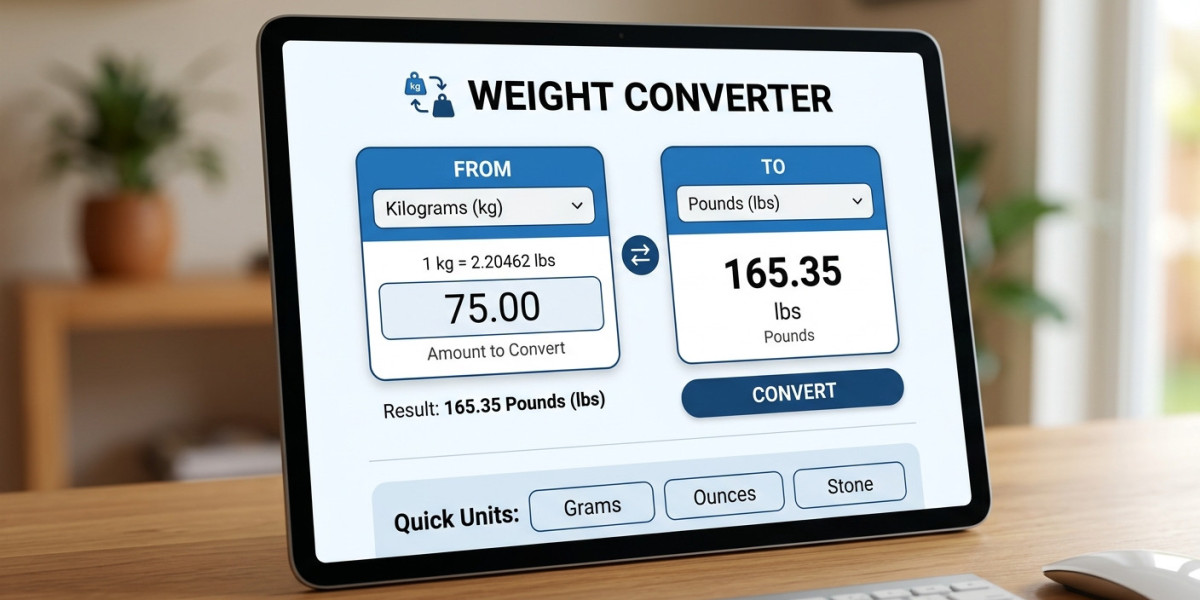

Weight and mass conversions come up more often than most people realize whether you're following an international recipe, checking a shipping label, tracking your fitness progress, or working through a science assignment that mixes kilograms with pounds. Manually converting between units like grams, kilograms, ounces, pounds, and stones is prone to small errors that can snowball into real problems, especially in professional or academic settings. That's where a reliable weight converter comes in, instantly translating any mass value into the unit you need without the guesswork of manual math.
Why Weight Conversion Still Trips People Up
Despite living in a globalized world, weight units remain far from standardized across countries and industries, which means confusion is common even among people who convert units regularly.
Why do different countries use different weight units?
The United States and a handful of other nations still rely on the imperial system, measuring weight in pounds and ounces, while most of the rest of the world has adopted the metric system, using kilograms and grams. This split traces back to historical trade practices and slow, incomplete standardization efforts throughout the 20th century. Even within countries that officially use the metric system, older units like stones persist in everyday conversation, particularly in the UK when discussing body weight.
What's the difference between weight and mass in everyday conversion?
Technically, mass measures the amount of matter in an object while weight measures the force of gravity acting on that mass, but in daily life and in virtually every online converter, the two terms are used interchangeably. Unless you're doing physics calculations involving different gravitational fields, treating weight and mass as equivalent for conversion purposes is standard practice and won't cause any practical issues.
Why do manual conversions lead to costly mistakes?
Manual conversion requires memorizing or looking up conversion factors, then performing multiplication or division correctly, and any small slip like using 2.2 instead of the more precise 2.20462 pounds per kilogram can compound over larger quantities. In fields like shipping, cooking, medicine dosing, or manufacturing, even a minor rounding error can lead to overcharges, ruined recipes, or safety concerns.
Common Units You'll Need to Convert Between
A comprehensive weight converter handles far more than just pounds and kilograms, covering the full spectrum of units used across different industries and countries.
What are the most commonly converted weight units?
The units people convert most frequently include kilograms (kg) and grams (g) from the metric system, pounds (lb) and ounces (oz) from the imperial system, and stones (st), which remain popular in the UK and Ireland for expressing body weight. Beyond these, milligrams are essential for precise measurements in cooking, pharmacy, and jewelry, while metric tons and US tons come into play for large-scale shipping and industrial applications.
How do you convert between metric and imperial weight units?
The core conversion factor to remember is that one kilogram equals approximately 2.20462 pounds, and one pound equals approximately 0.453592 kilograms. From there, grams and ounces follow proportionally, with one ounce equaling about 28.35 grams. A good converter tool handles all of these relationships instantly and displays results to whatever decimal precision you need, removing any risk of using outdated or imprecise conversion factors.
Which industries rely most heavily on accurate weight conversion?
Shipping and logistics companies convert weight constantly to calculate freight costs and comply with regulations across different countries, while the culinary world depends on precise gram-to-ounce conversions for baking consistency. The medical and pharmaceutical fields require exact conversions for dosing, and fitness and nutrition tracking apps convert between pounds and kilograms so users can log progress in their preferred unit.
How to Get the Most Accurate Results
Not all conversion methods are created equal, and understanding what separates a reliable tool from a rough estimate can save you from downstream errors.
What makes an online weight converter more accurate than mental math?
An online converter uses exact, standardized conversion constants rather than rounded approximations, and it performs the calculation instantly without the risk of arithmetic mistakes. This is especially valuable when converting unusual or precise values, like 173.4 grams into ounces, where mental math becomes impractical and error-prone.
How many decimal places should you use for weight conversions?
The right level of precision depends on context: everyday tasks like body weight or cooking typically only need one or two decimal places, while scientific, pharmaceutical, or industrial applications may require four or more decimal places to maintain accuracy. A flexible converter that lets you adjust precision on the fly is far more useful than one locked to a fixed number of decimals.
Can rounding errors actually matter in real-world situations?
Yes, particularly in cumulative or high-stakes contexts a small rounding error in a recipe scaled up for a restaurant, or in a shipping weight used to calculate freight charges across thousands of packages, can add up to significant discrepancies. Using a precise, standardized converter rather than rough mental estimates helps avoid these compounding issues entirely.
Practical Scenarios Where Conversion Matters Most
Understanding the theory behind weight conversion is useful, but seeing how it plays out in everyday situations makes the value of a reliable tool even clearer.
How does weight conversion affect international shipping costs?
Shipping carriers calculate rates based on weight, and international shipments often require converting between the sender's and recipient's unit systems to ensure accurate customs declarations and cost estimates. Getting this wrong can result in unexpected fees, customs delays, or disputes over shipping charges.
Why do recipes from different countries use different weight measurements?
Recipes from the UK, Australia, and much of Europe typically use grams and kilograms, while American recipes lean on ounces and pounds, so anyone cooking from international cookbooks or websites needs quick, reliable conversions to keep proportions correct. A single mismeasured ingredient, especially in baking where chemistry matters, can throw off an entire dish.
How do fitness enthusiasts use weight converters for tracking progress?
People tracking body weight, protein intake, or gym equipment loads often need to switch between kilograms and pounds depending on the source of their information, whether that's a scale, a nutrition label, or a workout program written for an international audience. Consistent, accurate conversion makes it easier to track progress over time without confusing or inconsistent numbers.
Whether you're managing an international shipment, following a recipe from abroad, tracking fitness goals, or handling any task that requires switching between weight units, having a fast and dependable tool matters. You can convert weights instantly and accurately using the weight converter on Multiconverters, which supports all major units and delivers precise results in seconds.