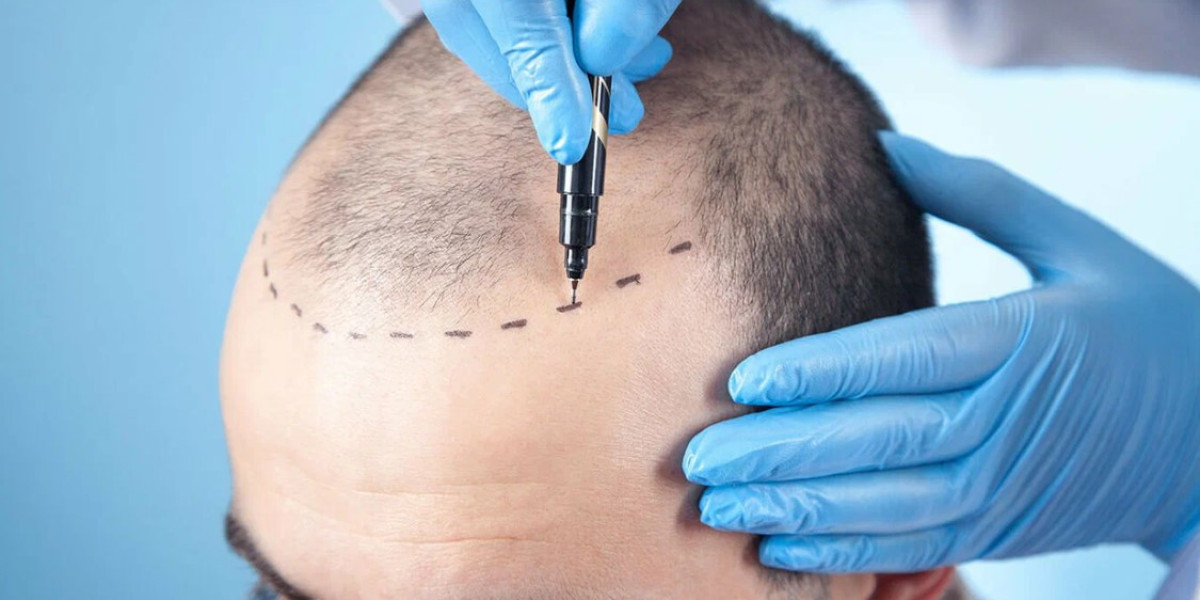

Hair Transplant in Dammam: How Many Grafts Are Needed? A Complete Guide
Deciding to undergo a hair restoration procedure is a significant step toward reversing the effects of hair loss and restoring your youthful appearance. For residents of the Eastern Province, opting for a hair transplant in Dammam provides access to advanced medical technology, skilled specialists, and permanent results. Hair transplant in Dammam is a popular solution for restoring natural hair growth, improving hair density, and boosting confidence with long-lasting, natural-looking results.
One of the most common questions prospective patients ask during their initial consultation is: "How many grafts will I need?"
The answer is not a single fixed number. Every individual experiences hair loss differently, meaning graft requirements vary drastically based on your unique anatomy, balding pattern, and aesthetic goals. Understanding how surgeons calculate graft counts can help you set realistic expectations before your procedure in Dammam.
What Exactly Is a "Graft"?
Before diving into numbers, it is essential to understand what a graft represents. A graft is not a single individual hair; rather, it is a naturally occurring grouping of hair follicles.
Human hair grows on the scalp in tiny bundles called follicular units, which typically contain anywhere from one to four hairs, along with tiny blood vessels, nerves, and sebaceous glands.
Single-Hair Grafts: Usually placed along the very front of the hairline to create a soft, natural, and irregular transition.
Multi-Hair Grafts (2 to 4 hairs): Implanted behind the hairline and across the mid-scalp or crown to build dense volume, coverage, and thickness.
When a clinic in Dammam quotes you a number—such as 2,500 grafts—they are referring to the total number of these individual follicular units harvested from your donor zone.
The Norwood Scale: Mapping Your Hair Loss
To estimate how many grafts you will need, hair restoration specialists typically rely on the Norwood Scale, a standardized classification system for male pattern baldness. The scale ranges from Stage 1 (minimal or no hair loss) to Stage 7 (severe baldness with only a horseshoe-shaped fringe remaining around the sides and back).
Here is a general breakdown of estimated graft requirements across different stages of hair loss:
1. Early Stages (Norwood Stages 2 to 3)
What it looks like: A receding hairline at the temples (often forming an "M" shape) or mild thinning at the front.
Estimated Grafts Needed: 1,500 to 2,500 grafts.
Goal: Rebuild a strong, natural frontal hairline and fill in minor temple recessions to frame the face properly.
2. Moderate Stages (Norwood Stages 4 to 5)
What it looks like: A deeply recessed hairline, a visibly thinning mid-scalp, and the beginning of vertex (crown) thinning.
Estimated Grafts Needed: 2,500 to 3,500 grafts.
Goal: Bridge the gap between the front and middle sections of the head while providing moderate density to the vertex.
3. Advanced Stages (Norwood Stages 6 to 7)
What it looks like: Extensive hair loss where the frontal region and crown bald patches have merged into one large area, leaving only the permanent donor zone on the sides and back.
Estimated Grafts Needed: 4,000 to 5,000+ grafts.
Goal: Maximize available donor hair to restore strategic coverage, focusing heavily on framing the face while accepting that full adolescent thickness may not be possible over a massive surface area.
Key Factors That Influence Your Graft Count
Beyond the Norwood Scale, several critical clinical variables dictate how many grafts your specific procedure in Dammam will require:
1. Hair Caliber and Texture
Hair characteristics play a massive role in visual density. Patients with coarse, curly, or thick hair shafts achieve greater optical coverage with fewer grafts because each individual hair occupies more visual space. Conversely, individuals with fine, straight, or light-colored hair require a higher density of grafts to achieve the same appearance of full coverage.
2. Scalp-to-Hair Contrast
The color contrast between your scalp skin and your hair color affects how many grafts you need. A person with dark hair and a pale scalp has high contrast, meaning any thinning is immediately visible, often requiring more grafts to eliminate transparency. Someone with matching hair and skin tones experiences less contrast, requiring fewer grafts to achieve an aesthetically pleasing result.
3. Donor Area Density and Capacity
The back and sides of your head—known as the safe donor zone—are finite resources. Your surgeon in Dammam must carefully evaluate your donor density (measured in hairs per square centimeter) and scalp laxity. Over-harvesting a donor zone to chase an unrealistic graft count can leave the back of your head looking patchy and thinned out. A responsible surgeon will balance your recipient needs against your donor capacity to protect long-term results.
4. Your Age and Future Hair Loss
If you are younger, your hair loss may still be progressing. Surgeons often design a conservative strategy that reserves some donor grafts for future touch-ups as your natural hair continues to age, rather than using your entire lifetime supply in a single session.
What to Expect During Your Dammam Consultation
Because every scalp is completely unique, reading online averages can only take you so far. The only way to determine your exact graft requirement is through a professional in-person or virtual consultation with a qualified hair restoration specialist in Dammam.
During your evaluation, the medical team will use specialized digital scalp microscopes to analyze your hair density, measure your balding surface area in square centimeters, and calculate your exact donor capacity. This ensures your procedure is meticulously tailored to your anatomy, providing a thick, natural, and permanent head of hair that lasts a lifetime.