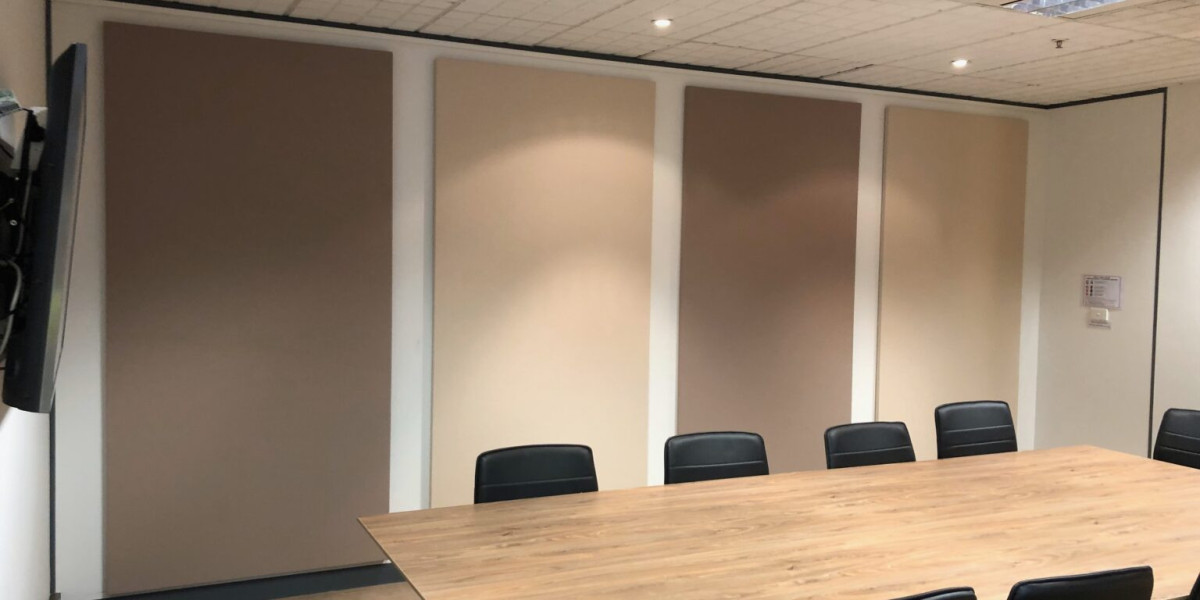

The brief was straightforward on paper: improve the acoustics of a curved exhibit gallery without compromising the architectural intent of the wall. In practice, that sentence contains almost every challenge acoustic treatment can throw at you.
The gallery in question is a mid-size cultural institution in Dubai. The exhibit wall runs approximately fourteen metres, follows a gentle convex curve, and was designed by the original architects to be a visual centrepiece — the kind of wall that has its own presence before anything is installed on it. The problem was that the same curved geometry that made it striking was creating significant flutter echo across the space, affecting the audio guides and making the gallery uncomfortable for extended visits.
We had worked with standard rectangular acoustic panels on previous gallery projects with good results. But a curved wall in a museum context rules out off-the-shelf solutions immediately — both because the geometry does not accommodate standard shapes and because the aesthetic standard is simply different. A fabrication manager on a previous project had mentioned shaheenacoustic specifically in the context of complex-shape work. That recommendation is what led us to make contact.
Why standard panels were never going to work here
A curved wall does not just create a sizing problem. It creates a sequencing problem. Each panel along the curve sits at a slightly different angle to its neighbour. If the panels are flat rectangles, gaps open up between them as the wall turns. You can close those gaps with filler, but in a museum environment, filler reads as a compromise immediately — and museum clients notice.
Beyond the geometry, the institution had specific requirements for how the treatment could interact with the wall surface. Adhesive fixing was ruled out to protect the original finish. Standard bracketing was not viable because the wall’s curvature made consistent bracket alignment impossible without custom fabrication. Whatever solution we specified had to be self-supporting or use a mounting approach designed for this specific wall.
The constraints before we had even looked at a single panel:
• Panel faces needed to follow the curve of the wall rather than bridge across it in flat sections.
• Edges between panels needed to meet cleanly without visible gaps or filler.
• Fabric selection had to complement the institution’s existing palette — the panels were going to be visible and prominent, not hidden.
• Mounting had to be reversible and non-damaging to the original wall surface.
The technical conversation that changed the approach
The initial conversation with Shaheen Acoustic was less a brief and more a problem-sharing session. We sent the wall drawings, the radius measurements, and photographs of the existing surface and the gallery lighting conditions. Their response came back with a proposed approach rather than a standard product recommendation.
The solution they proposed used CNC-cut panel cores shaped to follow the wall’s radius in plan. Rather than trying to bend a flat panel to fit a curve — which compromises the acoustic core — each panel substrate was cut to the correct arc geometry before wrapping. The result, once installed, would read as a continuous curved surface rather than a series of flat panels approximating one.
That distinction matters in a museum context more than almost anywhere else. The difference between a continuous curve and a faceted approximation is exactly the kind of detail that a curator or an architect notices on day one.
What the fabrication and installation involved
Shaheen Acoustic worked from the wall drawings to produce a panel layout that divided the fourteen-metre run into segments sized for practical handling and installation. Each segment was CNC-cut to the precise arc of its position on the wall — not a single generic radius applied across all of them, but the actual geometry of each panel’s location on the curve.
Fabric was selected in collaboration with the institution’s curatorial team. The chosen finish was a mid-tone that sat within the gallery’s existing colour language without drawing attention to itself — which is the correct outcome for acoustic treatment in a space where the exhibits are the point.
Installation used a purpose-built mounting system that attached to the wall without adhesive and allowed individual panels to be removed for maintenance or if the institution’s display requirements change in future. That reversibility was not incidental — it was a core requirement, and the fabrication approach was designed around it from the start.
The result in the gallery
What actually changed:
• The flutter echo is gone. The gallery now reads acoustically the way a curated space should — quiet enough to hear the audio guide clearly, contained enough that conversations in one part of the room do not carry across the full fourteen metres.
• The wall reads as a continuous curve. The CNC-cut geometry means panel edges meet cleanly along the arc. There are no visible gaps, no filler lines, no faceting. Visitors have no reason to look at the treatment rather than through it to the exhibits.
• The original wall surface is intact. The mounting system is fully reversible. If the institution repurposes the gallery in five years, the panels come down without damage to what is behind them.
• Complex-shape CNC capability made the brief possible. Without the ability to cut each panel core to the precise arc of its position on the wall, this project had no clean solution. Standard fabrication would have produced a visible compromise. The CNC approach produced a result that looks like it was always part of the architecture.
If you are working on a project where standard rectangular panels are not going to answer the geometry — a curved wall, an irregular ceiling soffit, a bespoke exhibit installation — it is worth a conversation before you assume the shape cannot be done. Their CNC Cutting for Acoustic Panels in Dubai service handles complex geometries as a standard capability, not a special exception.
What this project confirmed for us
Acoustic treatment in heritage or cultural spaces is a different discipline from acoustic treatment in offices or event venues. The margin for visible compromise is essentially zero. The brief cannot be answered with a product that was not designed for the specific geometry, and the fabrication partner has to understand both the acoustic requirement and the architectural one.
What made this project work was not a particularly complicated acoustic specification — the absorption requirement was straightforward. What made it work was fabrication that could follow the geometry precisely enough that the treatment disappeared into the space rather than sitting on top of it.