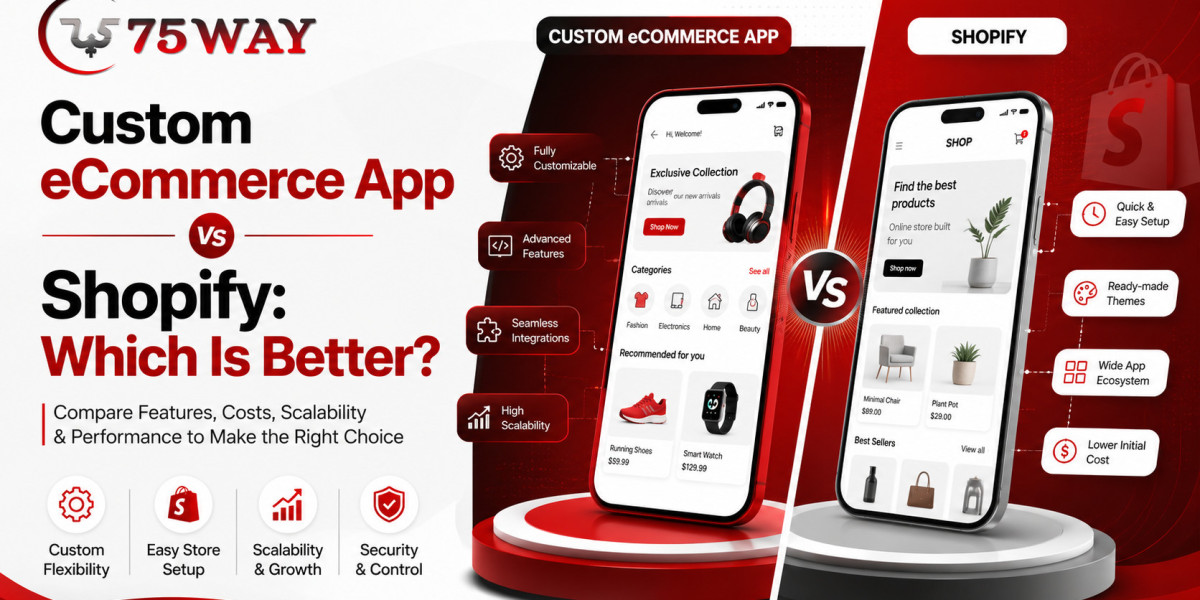

Launching an online store has never been easier, but choosing the right platform remains one of the biggest decisions for any business. While Shopify offers a quick way to start selling online, many growing brands eventually explore ecommerce app development to gain greater flexibility, improve customer experience, and build a stronger competitive advantage. The right choice depends on your business goals, budget, scalability requirements, and long-term growth strategy. This guide compares custom eCommerce applications and Shopify to help you determine which solution best fits your business.
Understanding the Two Options
Before making a comparison, it's important to understand what each option offers.
What Is Shopify?
Shopify is a hosted eCommerce platform that allows businesses to create online stores without building everything from scratch. It provides ready-made themes, payment integrations, inventory management, and a large ecosystem of apps that simplify store management.
It's particularly popular among startups and small businesses because it requires minimal technical expertise.
What Is a Custom eCommerce Application?
A custom eCommerce application is designed specifically for your business requirements. Instead of working within the limitations of a pre-built platform, developers create features, interfaces, and workflows tailored to your customers and operations.
Businesses investing in ecommerce app development services often choose custom solutions to achieve greater control, improved scalability, and unique customer experiences.
Feature Comparison
1. Ease of Setup
Shopify
One of Shopify's biggest advantages is simplicity.
A store can often be launched within days by selecting a theme, uploading products, configuring payments, and adding shipping options.
This makes Shopify ideal for businesses that need to enter the market quickly.
Custom Development
Building a custom application takes considerably longer because every component is planned, designed, developed, tested, and optimised specifically for your business.
Although development requires more time, the result is a solution built entirely around your goals.
Winner: Shopify
Design Flexibility
Shopify
Shopify offers hundreds of themes that can be customised to a certain extent.
However, extensive customisation may require additional coding or third-party applications.
Businesses using identical themes may end up with stores that look similar.
Custom Application
With custom development, every design element is created specifically for your brand.
This includes:
- Product browsing
- Checkout flow
- Customer dashboard
- Search functionality
- Navigation
- Loyalty programmes
There are virtually no creative limitations.
Winner: Custom Development
Business Scalability
Every growing business eventually reaches a point where standard solutions become limiting.
Custom-built platforms allow businesses to:
- Handle larger inventories
- Process higher traffic volumes
- Add advanced customer features
- Integrate enterprise software
- Expand internationally
Shopify supports growth well, but businesses with highly specialised requirements may eventually outgrow its capabilities.
When planning for long-term expansion, many organisations invest in ecommerce app development to build infrastructure that grows alongside their operations.
Winner: Custom Development
Performance
Website speed directly affects customer satisfaction and conversions.
Shopify
Shopify maintains reliable hosting infrastructure and generally delivers good performance.
However, excessive third-party apps may slow store performance.
Custom Solution
Developers can optimise every component specifically for speed.
Since only required features are included, applications often perform more efficiently.
Optimisations may include:
- Faster APIs
- Image optimisation
- Database tuning
- Intelligent caching
- Content delivery networks
Winner: Custom Development
Ownership and Control
One major difference lies in ownership.
Shopify
Your business operates within Shopify's ecosystem.
Although you own your products and customer relationships, platform limitations remain.
Certain features depend on Shopify's roadmap and available applications.
Custom Platform
A custom-built application provides complete ownership.
Businesses control:
- Features
- User experience
- Integrations
- Security
- Infrastructure
- Updates
- Future enhancements
This level of independence is especially valuable for companies pursuing unique digital strategies.
Integration Capabilities
Modern businesses rarely rely on one software platform.
Common integrations include:
- ERP systems
- CRM software
- Warehouse management
- Marketing automation
- Accounting software
- Shipping providers
- Analytics platforms
While Shopify supports numerous integrations, highly customised workflows sometimes require workarounds.
Custom development enables seamless integration with virtually any business system.
Security
Protecting customer information is essential for every online business.
Shopify manages:
- Hosting security
- SSL certificates
- Infrastructure maintenance
- PCI compliance
Businesses using custom solutions must ensure security is implemented correctly during development.
Professional developers follow industry best practices including:
- Secure authentication
- Encryption
- API protection
- Continuous monitoring
- Security updates
When developed correctly, both approaches offer strong protection.
Cost Comparison
Cost is often one of the first considerations.
Shopify Costs
Typical expenses include:
- Monthly subscription
- Premium themes
- Paid applications
- Transaction fees
- Additional integrations
While initial investment is relatively low, recurring costs increase as your store grows.
Custom Development Costs
Custom applications require a higher upfront investment.
However, businesses avoid ongoing platform subscription fees and gain complete ownership of the solution.
For companies expecting significant growth, long-term value often outweighs the higher initial cost.
User Experience
Customer experience plays a significant role in online sales.
Custom applications allow businesses to create highly personalised shopping journeys through:
- Personalised recommendations
- Custom checkout processes
- Interactive product visualisation
- Advanced search
- AI-powered assistance
- Loyalty features
Because every interaction is designed around customer behaviour, businesses can deliver experiences that strengthen brand loyalty and encourage repeat purchases.
AI Is Changing eCommerce
Artificial intelligence is reshaping how businesses interact with customers.
Beyond personalised recommendations and automated inventory management, AI-powered voice technology is becoming an important customer service tool.
For example, Talkoo.ai enables businesses to deploy intelligent AI voice agents that can answer product enquiries, assist with order tracking, handle frequently asked questions, qualify leads, and support customers through natural voice conversations. Instead of relying solely on human agents, businesses can provide instant assistance around the clock, improving customer satisfaction while reducing operational costs.
Integrating AI voice capabilities into an online shopping ecosystem helps create a more responsive and efficient customer experience.
Which Businesses Should Choose Shopify?
Shopify is an excellent option for:
- New startups
- Small businesses
- Individual entrepreneurs
- Businesses launching quickly
- Companies with limited technical resources
Its simplicity allows owners to focus on sales rather than infrastructure.
Which Businesses Should Choose Custom Development?
Custom development is better suited for:
- Growing enterprises
- Established retailers
- Multi-vendor marketplaces
- Subscription businesses
- Businesses with unique workflows
- Companies requiring advanced integrations
- Brands focused on long-term scalability
Organisations seeking specialised ecommerce mobile app development services often benefit from solutions tailored specifically to their operational needs rather than adapting their business to fit platform limitations.
Key Questions to Ask Before Deciding
Before selecting either option, consider:
- What is your long-term business vision?
- How quickly do you need to launch?
- Will your business require custom workflows?
- Do you expect significant growth?
- How important is complete ownership?
- What level of flexibility will you need in the future?
Your answers will help determine which solution aligns best with your objectives.
Choosing the Right Development Partner
Whether you choose Shopify customisation or a fully customised application, partnering with an experienced development company is critical.
A reliable technology partner provides:
- Strategic planning
- UI/UX expertise
- Secure development
- Performance optimisation
- Third-party integrations
- Ongoing maintenance
- Future scalability planning
Companies like 75way Technologies help businesses evaluate their goals and build scalable digital shopping solutions that balance functionality, performance, and long-term growth. By understanding both ready-made platforms and fully customised applications, experienced developers can recommend the approach that best supports your business objectives.
Final Verdict
There is no universal answer to whether Shopify or a custom eCommerce application is better.
Shopify offers speed, convenience, and affordability for businesses looking to launch quickly with minimal complexity.
Custom applications provide unmatched flexibility, scalability, ownership, and opportunities for innovation, making them the preferred choice for businesses planning sustained growth and differentiated customer experiences.
Rather than asking which platform is universally better, the more important question is which solution best supports your current needs while preparing your business for future success.
Frequently Asked Questions (FAQs)
1. Is Shopify better than a custom eCommerce application?
It depends on your business requirements. Shopify is ideal for quick launches and smaller businesses, while custom applications provide greater flexibility, scalability, and control.
2. When should I invest in ecommerce app development?
If your business requires advanced features, unique customer experiences, enterprise integrations, or long-term scalability, custom development is often the better choice.
3. Are custom applications more secure than Shopify?
Both can be highly secure when implemented correctly. Shopify manages infrastructure security, while custom applications rely on professional development practices and ongoing maintenance.
4. Can a custom application integrate with existing business software?
Yes. Custom applications can integrate with ERP systems, CRM platforms, payment gateways, inventory software, marketing tools, and many other business solutions.
5. Are ecommerce app development services suitable for startups?
Yes. While some startups choose Shopify initially, others with specialised business models may benefit from custom solutions that support future growth from the beginning.