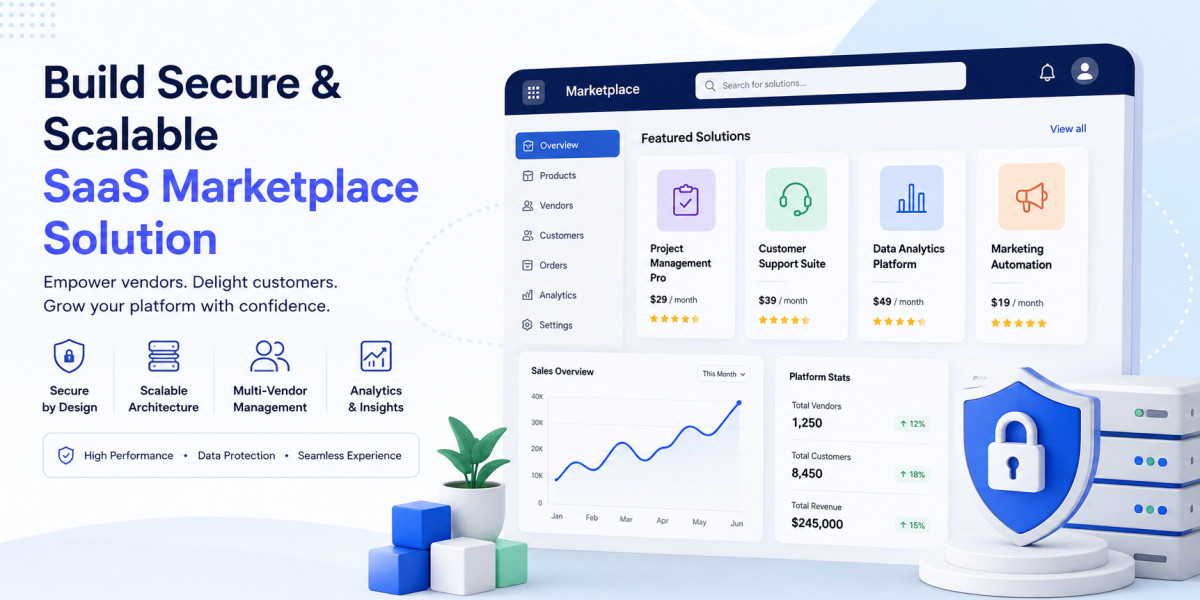

How to Build a Secure & Scalable SaaS Marketplace Solution
Introduction: Why SaaS Marketplaces Are the Future of B2B and B2C Commerce
A SaaS marketplace is a cloud-based platform where multiple vendors can list, sell, or offer services and software products to end users through a single, unified interface. Think of platforms like Salesforce AppExchange, Shopify App Store, or Upwork — each connects buyers and sellers at scale while handling billing, onboarding, and service delivery behind the scenes.
Businesses across industries are shifting toward this model because it removes friction from traditional commerce. Instead of managing dozens of vendor relationships manually, a marketplace centralizes discovery, transactions, and support. But building one isn't as simple as spinning up a website with a payment gateway. A true SaaS marketplace must be secure enough to protect sensitive user and payment data, and scalable enough to handle sudden spikes in traffic, vendors, and transactions without breaking down.
This guide walks through what it actually takes to build a SaaS marketplace that can grow with your business — from architecture decisions to security protocols to the features that keep users coming back.
Common questions this guide answers:
- What makes a SaaS marketplace different from a regular SaaS product?
- Which security measures are non-negotiable?
- How do you design for scalability from day one?
- What technology choices actually matter?
What Makes a SaaS Marketplace Different from a Regular SaaS App?
A single-tenant SaaS product typically serves one type of user with one clear value proposition. A marketplace, on the other hand, has to serve at least two distinct user groups simultaneously — vendors (sellers) and buyers — each with different needs, permissions, and workflows.
This dual-sided nature introduces complexity that single-product SaaS platforms don't face:
- Multiple user roles and permission tiers (admin, vendor, buyer, support staff)
- Vendor onboarding and verification workflows
- Commission structures and multi-party payment splitting
- Product or service listing management at scale
- Reviews, ratings, and dispute resolution systems
- Multi-tenant data isolation to keep each vendor's data separate and secure
Because of this complexity, the underlying architecture has to be planned carefully from the very beginning. Retrofitting security or scalability into a marketplace after launch is significantly harder — and riskier — than designing for it upfront.
Core Architecture Principles for a Marketplace That Lasts
Before writing a single line of code, the architectural foundation needs to support growth, security, and flexibility at the same time. A few guiding principles apply across almost every successful marketplace build:
- Multi-tenancy done right: Whether you choose a shared database with tenant IDs or isolated databases per vendor, the goal is the same — no vendor should ever be able to access another vendor's data, even accidentally.
- API-first design: Building the platform around well-documented APIs makes it easier to add mobile apps, third-party integrations, or new vendor tools later without rewriting the core system.
- Microservices over monoliths (when it makes sense): Breaking the platform into independent services — user management, billing, search, notifications — allows each part to scale independently and reduces the blast radius if one service fails.
- Event-driven communication: Using message queues between services (rather than direct, synchronous calls) helps the system stay responsive even under heavy load.
- Cloud-native infrastructure: Leveraging managed cloud services for compute, storage, and databases reduces operational overhead and gives you built-in scalability options.
Getting these decisions right early saves months of rework later and directly affects how smoothly the platform performs as usage grows.
Security: The Foundation You Can't Skip
Security in a SaaS marketplace isn't a single feature — it's a layer that touches every part of the platform, from how users log in to how vendor payouts are processed. A single vulnerability can expose thousands of vendors and customers at once, which is why marketplace security has to be treated as a first-class design requirement, not an afterthought.
Here are the security practices every SaaS marketplace should implement:
- Strong authentication and authorization: Use OAuth 2.0 or OpenID Connect for login, enforce multi-factor authentication for vendor and admin accounts, and apply role-based access control (RBAC) so users only see what they're permitted to.
- Data encryption everywhere: Encrypt sensitive data both at rest and in transit using industry-standard protocols like TLS 1.3 and AES-256.
- PCI-DSS compliance for payments: Never store raw card details yourself — route payments through PCI-compliant processors and tokenize sensitive payment data.
- Tenant data isolation: Ensure strict logical (or physical) separation between vendor data sets to prevent cross-tenant data leaks.
- Regular security audits and penetration testing: Schedule periodic third-party audits to catch vulnerabilities before attackers do.
- API rate limiting and abuse protection: Prevent brute-force attacks, scraping, and denial-of-service attempts with rate limiting, IP throttling, and bot detection.
- Comprehensive logging and monitoring: Maintain detailed audit trails so suspicious activity can be traced and investigated quickly.
- GDPR and data privacy compliance: If you serve users in regulated regions, build in consent management, data portability, and the right to be forgotten from the start.
Security isn't something you bolt on right before launch — it has to be baked into every architectural decision, every API endpoint, and every third-party integration you choose.
Scalability: Designing for Growth You Can't Predict
A marketplace's traffic pattern is rarely predictable. A single viral vendor listing, a seasonal sales event, or a successful marketing campaign can send traffic soaring overnight. If the platform isn't built to scale horizontally, this kind of spike can cause slowdowns, failed transactions, and lost trust.
Key scalability strategies include:
- Horizontal scaling over vertical scaling: Design services so you can add more servers rather than relying on a single, larger machine that eventually hits a ceiling.
- Load balancing: Distribute incoming traffic evenly across multiple servers to avoid any single point of failure.
- Caching at multiple layers: Use in-memory caches like Redis for frequently accessed data (product listings, search results, session data) to reduce database load.
- Database optimization and sharding: As data grows, partition large tables and use read replicas to keep query performance fast.
- Auto-scaling infrastructure: Configure cloud resources to automatically scale up during traffic spikes and scale down during quiet periods, keeping costs efficient.
- Content Delivery Networks (CDNs): Serve static assets and media closer to users geographically to reduce latency.
- Asynchronous processing: Offload non-urgent tasks (emails, notifications, report generation) to background job queues so they don't block core marketplace operations.
Organizations that specialize in building on-demand and scalable platforms often approach this stage with a dedicated saas marketplace development services methodology — one that stress-tests infrastructure against realistic growth scenarios before launch rather than reacting to problems after they occur. Getting this groundwork right early is what separates marketplaces that scale gracefully from those that collapse under their own success.
Must-Have Features for a Modern SaaS Marketplace
Beyond the technical backbone, the features you build directly shape how vendors and buyers experience the platform. Some of the most important include:
- Vendor onboarding and verification: A smooth, guided process for vendors to register, submit documentation, and get approved.
- Advanced search and filtering: Buyers need to find relevant products or services quickly, which means investing in strong search indexing and filtering logic.
- Flexible subscription and billing models: Support for one-time purchases, recurring subscriptions, tiered pricing, and usage-based billing.
- Automated commission and payout management: Transparent, automated calculation and distribution of vendor earnings.
- Reviews and ratings system: Builds trust between buyers and vendors while giving the platform valuable quality signals.
- In-app messaging and support: Reduces friction by letting buyers and vendors communicate directly within the platform.
- Analytics dashboards: Give vendors visibility into their sales performance and give platform admins insight into overall marketplace health.
- Dispute resolution workflows: A structured process for handling refunds, complaints, and conflicts fairly.
Each of these features adds real value, but they should be prioritized based on your specific marketplace model rather than implemented all at once. Launching lean with the essentials and iterating based on real user feedback tends to outperform trying to build every feature before day one.
Choosing the Right Technology Stack
There's no single "correct" tech stack for a SaaS marketplace, but certain choices consistently perform well for this type of platform:
- Backend frameworks: Node.js, Python (Django/FastAPI), or Java (Spring Boot) are common choices for handling high-concurrency marketplace logic.
- Frontend frameworks: React or Next.js are popular for building responsive, fast-loading interfaces with strong SEO support.
- Databases: PostgreSQL or MySQL for relational data, paired with a NoSQL option like MongoDB for flexible, high-volume data such as activity logs or product catalogs.
- Cloud providers: AWS, Google Cloud, or Azure — all offer mature tools for auto-scaling, managed databases, and serverless functions.
- Payment infrastructure: Stripe Connect or similar platforms designed specifically for multi-party marketplace payments and payouts.
- Search engines: Elasticsearch or Algolia for fast, relevant product and vendor search.
The right stack depends on your team's expertise, your budget, and your long-term scalability goals — but consistency and maintainability should always outweigh chasing the newest trend.
Common Challenges (and How to Solve Them)
Even well-planned marketplace builds run into recurring obstacles. Knowing them ahead of time helps you plan around them:
- Chicken-and-egg problem: Attracting vendors without buyers, or buyers without vendors, is one of the hardest early challenges. Solve it by seeding the platform with a curated set of quality vendors before a broad public launch.
- Maintaining data consistency across services: In a microservices architecture, keeping data in sync can get complicated. Event-driven patterns and clear data ownership per service help mitigate this.
- Balancing customization with standardization: Vendors often want flexibility, but too much customization slows development and complicates maintenance. Offer configurable templates instead of fully custom builds.
- Managing trust and safety at scale: As the platform grows, manual moderation becomes unsustainable. Invest early in automated fraud detection and content moderation tools.
- Avoiding vendor lock-in on your own infrastructure: Design your systems so switching cloud providers or payment processors later doesn't require a full rebuild.
Choosing the Right Development Partner
Building a secure, scalable SaaS marketplace requires a blend of skills that's genuinely hard to find in-house — cloud architecture, security engineering, payment systems expertise, and product design all need to work together seamlessly. This is why many businesses choose to partner with a specialized development team rather than building entirely from scratch.
Expandorix is one such technology partner known for helping businesses design and launch multi-vendor SaaS platforms with a strong emphasis on security-first architecture and scalable cloud infrastructure. Working with a team that has already solved these architectural and security challenges across multiple marketplace builds can significantly reduce both development time and long-term technical risk.
When evaluating a development partner, look for:
- Proven experience with multi-tenant SaaS architecture
- A clear security and compliance track record
- Case studies or references from similar marketplace projects
- Transparent communication around timelines and technical trade-offs
- Post-launch support and scalability planning, not just initial delivery
Conclusion: Build for Today, Architect for Tomorrow
A successful SaaS marketplace isn't just about launching fast — it's about building a foundation that can support growth without constant firefighting. Security has to be woven into every layer of the platform, and scalability has to be planned for before it becomes an emergency rather than after.
The businesses that get this right treat their marketplace as a long-term product, not a one-time project. They invest in the right architecture, the right security practices, and the right team from the very beginning.
If you're planning to build a SaaS marketplace and want a partner who understands both the technical depth and the business strategy behind it, Expandorix has the experience to help turn that vision into a secure, scalable platform ready for real-world growth.