
Running a small business in 2026 is not what it was five years ago. Customer expectations are higher. Competition is fiercer. And the margin for operational inefficiency has nearly disappeared. What separates businesses that grow steadily from those that stall is rarely the product alone — it is often the technology infrastructure quietly working behind the scenes.
The phrase "tech stack" used to sound like something only Silicon Valley startups worried about. Today, it applies to every business — a boutique travel agency, a regional logistics firm, an independent retailer, or a local service provider. Your tech stack is simply the collection of tools, platforms, and integrations your business runs on. Get it right, and everything becomes faster, smarter, and more scalable. Get it wrong, and you spend your days chasing data across disconnected systems, manually re-entering information, and fighting fires instead of building your business.
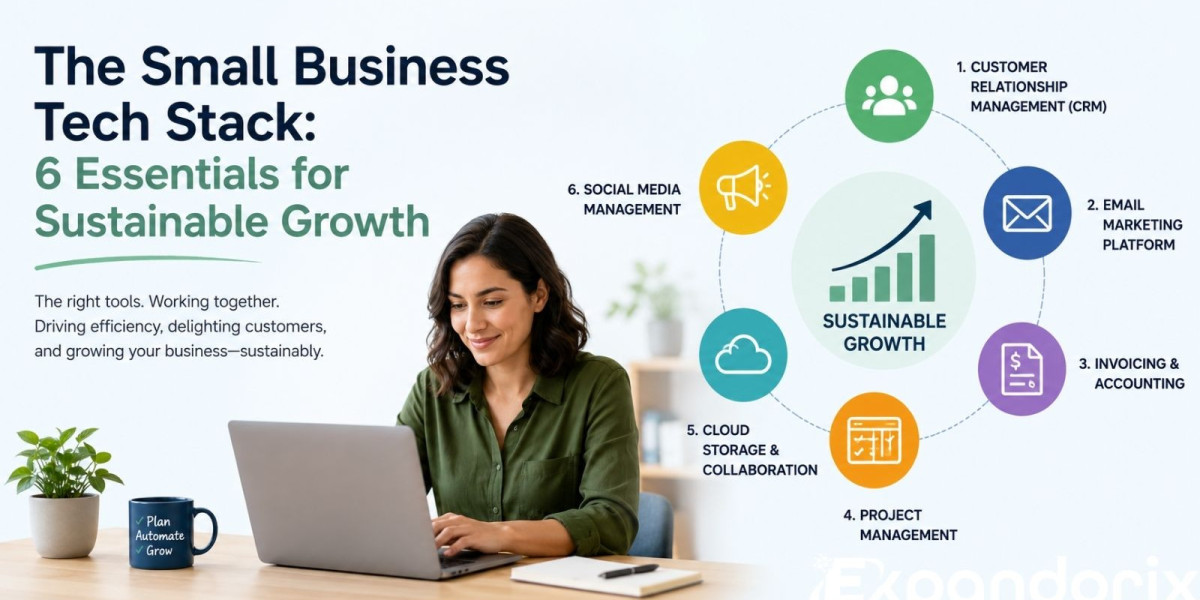
This guide breaks down the six technology essentials every small business needs to build a sustainable, growth-ready operation — and explains why each one matters more than most business owners realise.
1. A Centralised Digital Platform
Every growing business eventually hits a wall caused by fragmentation. Sales data lives in one spreadsheet. Customer records are stored in a different tool. Inventory is tracked in a third system. And nobody is quite sure which version of the data is correct.
A centralised digital platform solves this by creating a single source of truth — one unified system where your team can access accurate, real-time information. This is not just about convenience. It is about making better decisions, faster.
The advantages of centralisation are immediate and compounding:
• Manual data entry drops significantly, reducing errors and saving hours of administrative work each week.
• Version conflicts disappear because every team member is working from the same live data.
• Customer experiences improve because staff can pull up accurate order, booking, or account information instantly.
• Reporting becomes easier — you can generate meaningful insights without manually aggregating data from multiple places.
For businesses operating in travel, hospitality, retail, or services, this kind of centralised infrastructure is not a luxury — it is the foundation everything else is built on.
2. Secure API Integrations
A platform is only as powerful as its connections. API integrations — the technical bridges that allow different software systems to talk to each other — are what allow your business to operate as a cohesive unit rather than a collection of isolated tools.
When your booking engine connects directly to your payment gateway, your CRM, and your reporting dashboard through secure APIs, data flows automatically and in real time. You do not need a team member to manually export a CSV from one system and import it into another. The systems do the work.
For businesses in sectors like travel and tourism, this is particularly critical. Global Distribution System (GDS) integrations, for example, allow travel agencies to access live inventory from airlines, hotels, and car rental providers — all without switching between portals or making phone calls to confirm availability.
What makes API integrations essential rather than optional:
• Real-time data sync eliminates the lag that causes booking errors, overselling, and customer complaints.
• Secure, well-documented APIs reduce the risk of data breaches and ensure compliance with privacy regulations.
• Connected systems reduce operational costs by automating workflows that previously required human intervention.
• As your business grows, APIs allow you to plug in new tools without rebuilding your entire infrastructure.
The key word here is "secure." Not all integrations are built equally. Businesses should always work with technology partners who prioritise data security, use encrypted connections, and keep their API documentation up to date.
3. SaaS and Cloud-Based Solutions
One of the most significant shifts in small business technology over the past decade is the move from on-premise software to cloud-based, Software-as-a-Service (SaaS) solutions. And the reason is straightforward: SaaS works the way small businesses actually need to operate.
Traditional software required large upfront investments in licences and hardware, dedicated IT staff to manage updates and maintenance, and long implementation timelines before you saw any value. SaaS flips that model entirely.
With cloud-based solutions, you pay for what you use — typically through a monthly or annual subscription. Updates and security patches are handled automatically by the vendor. New features roll out without downtime. And your team can access the platform from anywhere, on any device, as long as they have an internet connection.
For small businesses, the practical benefits are significant:
• Lower upfront costs mean more capital available for marketing, hiring, and product development.
• Automatic updates ensure you are always running the latest, most secure version of the software.
• Cloud access supports remote and hybrid work models, which are now standard expectations for many employees.
• Scalability is built in — you can increase or decrease your usage as your business needs change, without costly migrations.
Whether it is a cloud-based CRM, an online accounting platform, a project management tool, or a SaaS marketplace solution, the flexibility and cost-efficiency of cloud technology make it the obvious choice for small businesses building for the long term.
4. Business Automation
Every business has tasks that repeat themselves. Confirmation emails. Inventory updates. Invoice generation. Appointment reminders. Follow-up messages to prospects. These are not complex tasks — but they consume enormous amounts of time when done manually, and they introduce errors when done inconsistently.
Business automation is the process of using software to handle these repetitive workflows without human intervention. A well-designed automation triggers the right action at the right moment — every time, without fail.
Here is what effective automation looks like in practice:
• When a customer makes a booking, a confirmation email is sent automatically within seconds.
• When stock drops below a defined threshold, a purchase order is generated and sent to the supplier.
• When a lead fills in a contact form, they are added to a nurture sequence and assigned to a sales team member.
• When a subscription renewal is approaching, a reminder is sent to the customer seven days in advance.
The cumulative effect of these automations is substantial. Your team spends less time on administrative tasks and more time on work that genuinely requires human judgment — building relationships, solving complex problems, and developing your product or service.
Automation also improves consistency. Human beings make mistakes when performing repetitive tasks, especially under pressure. Automated workflows do not. They follow the rules exactly, every time, which means fewer errors, fewer customer complaints, and fewer costly corrections.
For small businesses competing with larger players who have dedicated operations teams, automation is one of the most effective ways to level the playing field.
5. Mobile-Ready Infrastructure
Consider how your customers interact with your business today. They search for your services on their phones. They check their booking confirmations on mobile. They make enquiries through WhatsApp or social media. They expect to complete transactions on whatever device is in their pocket at that moment.
Now consider your team. Field staff need access to operational tools while they are on the move. Sales representatives want to check CRM data before a client call, without waiting to get back to a desktop. Managers need real-time reporting they can review on the go.
A tech stack that is not mobile-ready creates friction at both ends — for your customers and for your team. And in an environment where user experience is a major competitive differentiator, friction is expensive.
Mobile readiness means more than having a website that looks acceptable on a small screen. It means your core operational platforms are designed for mobile use from the ground up. It means your small business technology ecosystem is accessible, responsive, and fully functional across all devices — not just tolerable on mobile as an afterthought.
What to look for when evaluating mobile readiness:
• Responsive design that adapts cleanly to different screen sizes without losing functionality.
• Native mobile apps for core platforms where deep functionality is required.
• Offline capability for tools that field teams need to use in low-connectivity environments.
• Mobile-optimised checkout and payment flows for customer-facing platforms.
Businesses that invest in mobile-ready infrastructure see higher customer satisfaction scores, lower abandonment rates on digital transactions, and greater productivity from field-based teams. It is not a niche requirement — it is a baseline expectation.
6. Strategic Technology Consulting
The five pillars above are all important. But there is a sixth essential that ties them all together — and it is the one that small businesses most often overlook: strategic technology consulting.
Technology investment without a clear strategy is one of the most common and costly mistakes small businesses make. It usually looks something like this: a team adopts a new CRM because a sales rep recommended it. A different department subscribes to a project management tool. IT sets up a cloud server. And suddenly, the business is paying for four systems that do not integrate, two of which overlap in functionality, and none of which were selected with the company's actual growth goals in mind.
Strategic technology consulting means working with experienced advisors who assess your current infrastructure, understand your business objectives, and build a technology roadmap that actually serves where you want to go — not just where you are today.
A good technology consultant or partner will:
• Audit your existing systems to identify inefficiencies, redundancies, and security gaps.
• Recommend solutions that integrate cleanly with your current stack, rather than creating new silos.
• Prioritise investments based on where technology will have the greatest impact on your business goals.
• Plan for scale — ensuring the tools you adopt today will support your business as it grows.
• Keep you informed about emerging technologies that could give your business a competitive advantage.
Many small businesses assume they cannot afford strategic technology guidance. In reality, the cost of getting technology wrong — through poor integration, duplicated tools, or data security failures — far exceeds the cost of getting proper advice upfront
Putting It All Together: Your Tech Stack as a Competitive Advantage
These six essentials are not independent checkboxes. They work best when they are designed as a coherent system — where your centralised platform connects to your integrated APIs, your automation runs across cloud-based tools, your team accesses everything on mobile, and your strategy ensures all of it serves your growth goals.
A small business with this kind of integrated, well-designed tech stack can:
• Serve customers faster and more accurately than competitors running manual processes.
• Scale operations without proportionally scaling headcount.
• Make data-driven decisions because reliable information is always available.
• Adapt quickly to changes in the market because flexible, cloud-based tools allow rapid adjustments.
• Compete with larger businesses that have greater resources — because the right technology is a great equaliser.
The question is not whether your business needs a strong tech stack. It already does. The question is whether the one you have is working for you or against you.
Final Thoughts
Building the right technology foundation takes careful planning, the right partners, and a willingness to invest in infrastructure that pays dividends over time. It is not about adopting every new tool that comes along — it is about building a connected, scalable, and secure system that supports your business at every stage of growth.
Whether you are just beginning to digitise your operations or looking to upgrade a fragmented existing setup, the six essentials outlined in this guide provide a practical framework for making technology decisions that actually move the needle.
If you are looking for an experienced technology partner to help you build or refine your small business tech stack, Expandorix works with businesses across travel, retail, and services to design and implement tailored technology solutions — from API integrations and SaaS platforms to automation systems and mobile-ready infrastructure.
The right technology is not an expense. It is an investment in everything your business is working toward.