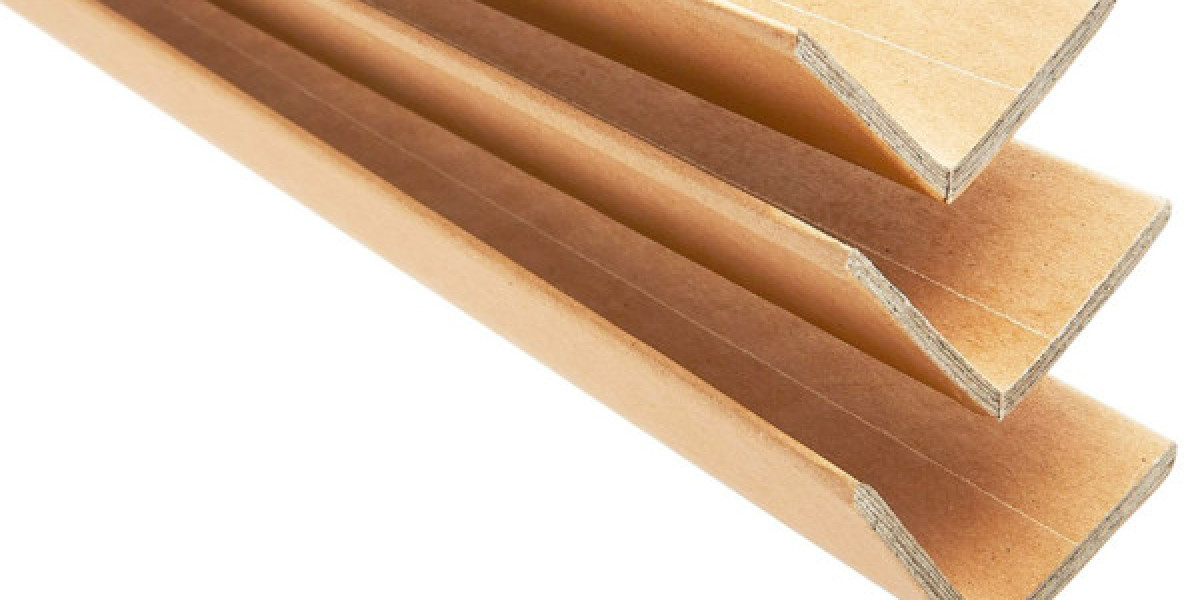

The demand for L Shaped Paper Angle Board has increased significantly across packaging, logistics, warehousing, and export industries. As global trade expands and businesses focus on safer and more sustainable packaging solutions, angle boards have become a critical material for protecting goods during storage and transportation.
An L shaped paper angle board is a simple yet highly effective packaging product used to reinforce edges, stabilize pallets, and prevent damage during shipping. Despite its simple structure, it plays a powerful role in reducing product loss, improving load stability, and supporting eco-friendly packaging initiatives.
This guide explores everything you need to know about L shaped paper angle boards, including their uses, manufacturing process, benefits, applications, and how to choose the right supplier.
What Is an L Shaped Paper Angle Board?
An L Shaped Paper Angle Board is a protective packaging material made from layers of recycled paper or kraft paper bonded together and formed into a rigid L-shaped profile.
It is designed to:
Protect product edges
Reinforce pallet loads
Prevent crushing during transport
Improve stacking stability
The L-shape structure provides strength along corners, making it ideal for securing heavy or fragile goods.
Structure of L Shaped Paper Angle Board
The design may look simple, but it is engineered for strength and durability.
Main Components
Kraft Paper Layers
High-strength recycled paper forms the base material.Adhesive Bonding
Water-based adhesives are used to bond multiple layers.Compression Forming
Layers are pressed and shaped into a rigid L-angle structure.Cut-to-Length Finishing
Boards are cut into required sizes for industrial use.
Common Thickness Options
2 mm
3 mm
4 mm
5 mm
Custom heavy-duty sizes
Key Features of L Shaped Paper Angle Board
The popularity of this packaging material is due to its strong performance features:
1. High Compression Strength
It can withstand heavy stacking loads without bending or breaking.
2. Edge Protection
Protects corners of cartons, boxes, and palletized goods.
3. Lightweight Design
Despite its strength, it is lightweight and easy to handle.
4. Eco-Friendly Material
Made from recyclable paper, making it sustainable and biodegradable.
5. Cost-Effective Packaging Solution
Reduces damage-related losses and lowers packaging costs.
6. Easy to Customize
Can be manufactured in different lengths, widths, and thicknesses.
How L Shaped Paper Angle Boards Are Manufactured
Understanding the production process helps explain why these boards are strong and reliable.
Step 1: Paper Selection
High-quality kraft paper or recycled paper is selected based on strength requirements.
Step 2: Adhesive Application
Layers are coated with water-based adhesive for bonding.
Step 3: Layer Compression
Multiple paper layers are compressed under high pressure.
Step 4: L-Shape Formation
The compressed sheets are shaped into a 90-degree angle using forming machines.
Step 5: Drying and Hardening
Boards are dried to increase rigidity and stability.
Step 6: Cutting and Packaging
Final products are cut into standard or custom sizes.
Major Applications of L Shaped Paper Angle Board
L shaped angle boards are used across many industries for protection and stabilization.
1. Pallet Packaging
Used to secure pallet loads during shipping and storage.
2. Export Packaging
Protects goods during long-distance international transport.
3. Furniture Industry
Prevents damage to corners of wooden and upholstered furniture.
4. Electronics Packaging
Protects fragile electronic products such as TVs and appliances.
5. Construction Materials
Used for reinforcing tiles, glass panels, and steel sheets.
6. Food and Beverage Industry
Provides structural support for stacked cartons.
Benefits of Using L Shaped Paper Angle Board
The advantages of using this packaging solution are significant for businesses.
1. Prevents Product Damage
It reduces breakage and corner damage during transit.
2. Improves Load Stability
Keeps stacked goods aligned and stable.
3. Reduces Packaging Costs
Minimizes the need for heavy wooden or plastic reinforcements.
4. Environmentally Friendly
Supports sustainable packaging goals by reducing plastic usage.
5. Lightweight but Strong
Does not add significant weight to shipments.
6. Enhances Branding Opportunity
Can be customized with printed logos or labels
L Shaped Paper Angle Board vs Other Packaging Materials
1. Compared to Wooden Corner Boards
Paper angle boards are lighter
More eco-friendly
Lower cost
Easier disposal
2. Compared to Plastic Edge Protectors
Biodegradable advantage
Lower environmental impact
Better recyclability
3. Compared to Metal Reinforcements
Safer handling
Lower weight
Cost-effective for shipping
Factors to Consider When Choosing L Shaped Paper Angle Board
Selecting the right angle board is important for packaging performance.
1. Load Weight Capacity
Heavier loads require thicker boards.
2. Thickness and Size
Choose based on product dimensions and stacking needs.
3. Paper Quality
Higher GSM kraft paper improves strength.
4. Moisture Resistance
Some boards are treated for humidity protection.
5. Custom Requirements
Industries may require printed or branded boards.
Why Industries Prefer L Shaped Paper Angle Board
Several factors make this packaging solution widely preferred:
Strong protection for edges
Affordable bulk pricing
Easy handling and storage
Compliance with export packaging standards
Reduced shipping damage claims
Industries focused on efficiency and sustainability increasingly rely on angle boards.
Environmental Impact of L Shaped Paper Angle Board
One of the biggest advantages is sustainability.
Eco Benefits Include:
Made from recycled paper
Fully recyclable after use
Reduces plastic packaging waste
Supports green supply chain initiatives
Companies adopting eco-friendly packaging often choose paper angle boards as part of their sustainability strategy.
Global Demand and Market Growth
The global packaging industry has seen rising demand for protective solutions like L shaped angle boards.
Growth Drivers:
Expansion of e-commerce
Increased international trade
Focus on sustainable packaging
Growth in logistics and warehousing sectors
Countries with strong export industries heavily use angle boards for pallet stabilization.
Common Industries Using L Shaped Paper Angle Board
Logistics and freight companies
Manufacturing industries
Export-import businesses
Retail supply chains
Construction material suppliers
Furniture manufacturers
Storage and Handling Guidelines
Proper handling ensures maximum efficiency:
Store in dry conditions
Avoid direct water exposure
Keep stacked horizontally
Do not overload storage piles
Use appropriate size for each pallet
Future Trends in L Shaped Paper Angle Boards
The packaging industry is evolving, and angle boards are improving as well.
1. Smart Packaging Integration
Future designs may include tracking or labeling systems.
2. Stronger Lightweight Materials
Research is focused on increasing strength without adding weight.
3. Increased Automation in Production
Manufacturing processes are becoming more efficient.
4. Eco-Friendly Innovations
More biodegradable adhesives and materials are being introduced.
Conclusion
The L Shaped Paper Angle Board is a vital packaging solution in modern logistics and supply chain management. Its ability to protect edges, stabilize loads, and reduce shipping damage makes it an essential material across multiple industries.
With increasing demand for sustainable and cost-effective packaging, paper angle boards are becoming a preferred choice over traditional materials like wood and plastic.
Businesses that adopt L shaped paper angle boards benefit from reduced costs, improved safety, and stronger environmental compliance, making them a smart investment for long-term packaging efficiency.
FAQs
1. What is an L shaped paper angle board used for?
It is used to protect edges, stabilize pallet loads, and prevent damage during shipping and storage.
2. Is L shaped paper angle board strong enough for heavy loads?
Yes, it is designed to support heavy stacking when the correct thickness is used.
3. Is it eco-friendly?
Yes, it is made from recyclable paper and is fully biodegradable.
4. Can it be customized?
Yes, it can be customized in terms of size, thickness, and printing.
5. What industries use angle boards the most?
Logistics, manufacturing, furniture, electronics, and export industries.
6. How does it compare to plastic edge protectors?
It is more sustainable, cost-effective, and environmentally friendly.