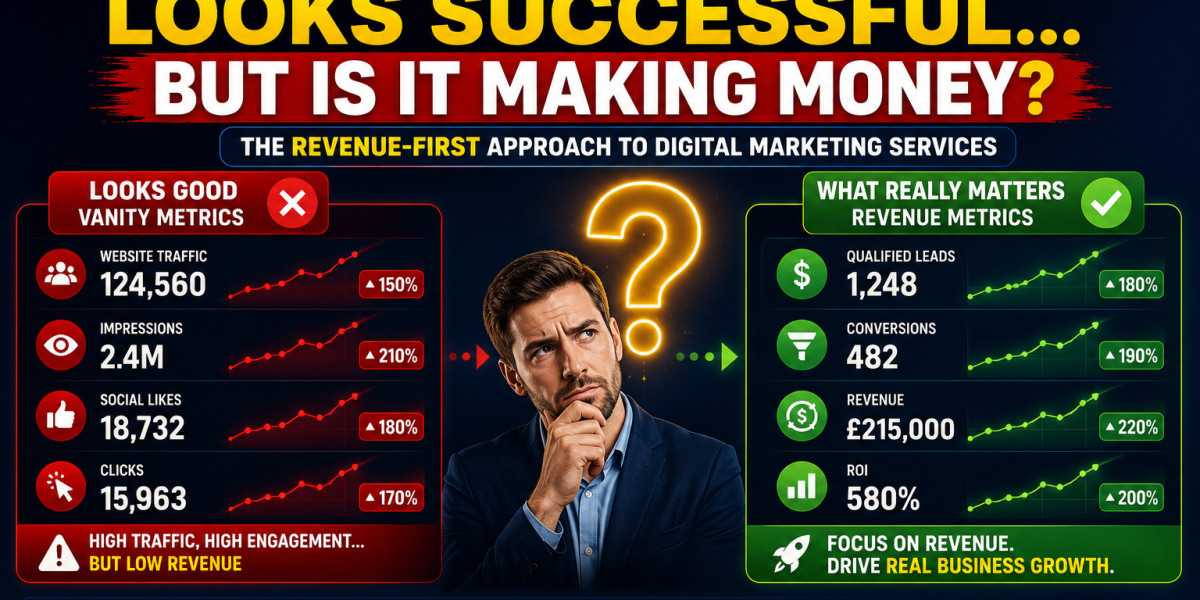

Many businesses measure marketing success using metrics such as website traffic, social media followers, impressions, and clicks. While these numbers can provide useful insights, they don't always translate into what matters most: revenue.
A growing number of organizations are shifting toward a revenue-first approach to digital marketing services. Instead of focusing solely on vanity metrics, this strategy prioritizes activities that directly contribute to lead generation, customer acquisition, and business growth.
The ultimate goal isn't simply attracting visitors—it's turning those visitors into paying customers and creating a predictable path to revenue growth.
In this article, we'll explore what a revenue-first approach to digital marketing services looks like and why it's becoming essential for modern businesses.
What Is a Revenue-First Marketing Strategy?
A revenue-first marketing strategy focuses on measurable business outcomes rather than surface-level engagement metrics.
Instead of asking:
- How many website visitors did we get?
- How many likes did our posts receive?
- How many impressions did our ads generate?
Businesses ask:
- How many qualified leads were generated?
- How many sales were closed?
- What was the customer acquisition cost?
- How much revenue did the campaign generate?
This shift helps businesses align marketing activities with overall business objectives.
Why Vanity Metrics Can Be Misleading
Traffic and engagement are important, but they don't automatically generate revenue.
For example:
- A website may receive thousands of visitors but generate few inquiries.
- Social media posts may receive hundreds of likes but no sales.
- Advertising campaigns may attract clicks without producing conversions.
Without connecting marketing performance to revenue, businesses risk investing in activities that deliver little business value.
The Core Components of Revenue-Driven Digital Marketing Services
A revenue-first strategy relies on several interconnected services working together.
Search Engine Optimization (SEO)
SEO helps attract potential customers actively searching for products and services.
Unlike broad awareness campaigns, SEO targets users with high purchase intent.
Benefits include:
- Qualified traffic
- Consistent lead generation
- Lower acquisition costs
- Long-term growth
When optimized correctly, SEO becomes a reliable source of revenue-generating opportunities.
Pay-Per-Click (PPC) Advertising
PPC campaigns allow businesses to reach prospects who are ready to take action.
A revenue-focused PPC strategy emphasizes:
- Conversion tracking
- Lead quality
- Return on ad spend (ROAS)
- Customer acquisition costs
Rather than focusing solely on clicks, successful PPC campaigns prioritize profitability.
Content Marketing
Content marketing plays a crucial role in guiding prospects through the buying journey.
Effective content helps businesses:
- Build trust
- Educate potential customers
- Address objections
- Improve conversions
Revenue-driven content is designed to move prospects closer to purchasing decisions rather than simply generating page views.
Conversion Rate Optimization (CRO)
Increasing traffic is only part of the equation.
Businesses must also maximize the value of existing traffic.
CRO focuses on:
- Landing page improvements
- User experience enhancements
- CTA optimization
- Form simplification
- Funnel optimization
Small increases in conversion rates can significantly increase revenue without increasing marketing spend.
Understanding the Customer Journey
Revenue growth depends on understanding how customers move from awareness to purchase.
A revenue-first digital marketing strategy maps each stage of the customer journey:
Awareness
Potential customers discover your business through:
- Search engines
- Social media
- Content marketing
- Advertising
Consideration
Prospects compare solutions and evaluate providers.
Businesses can influence this stage through:
- Case studies
- Testimonials
- Educational content
- Product demonstrations
Decision
At this stage, prospects are ready to buy.
Strong calls-to-action, trust signals, and streamlined user experiences help convert prospects into customers.
Using Data to Drive Revenue Growth
One of the biggest advantages of digital marketing services is access to measurable data.
Businesses can track:
- Lead sources
- Conversion rates
- Customer acquisition costs
- Revenue attribution
- Customer lifetime value
These insights help organizations identify which marketing activities contribute most effectively to revenue growth.
Marketing Automation Improves Efficiency
Revenue-focused businesses use automation to nurture leads and improve conversion rates.
Automation can help with:
- Email campaigns
- Lead scoring
- Follow-up sequences
- Audience segmentation
- Customer engagement
By maintaining communication throughout the customer journey, businesses increase the likelihood of conversion.
Aligning Marketing and Sales Teams
A common challenge for many organizations is the disconnect between marketing and sales.
Revenue-focused digital marketing services bridge this gap by ensuring both teams work toward shared goals.
This includes:
- Lead qualification criteria
- Shared reporting systems
- Conversion tracking
- Revenue accountability
When marketing and sales operate together, customer acquisition becomes more efficient.
Why Revenue-Focused Marketing Delivers Better Results?
Businesses that adopt a revenue-first approach often experience:
- Higher ROI
- Better lead quality
- Improved conversion rates
- More predictable growth
- Stronger customer relationships
Instead of chasing traffic and engagement alone, these organizations focus on activities that directly impact profitability.
Common Mistakes Businesses Make
Many businesses struggle to achieve revenue growth because they:
- Prioritize traffic over conversions
- Ignore customer intent
- Fail to track meaningful metrics
- Lack lead nurturing systems
- Use disconnected marketing strategies
Avoiding these mistakes helps create a more effective and profitable marketing strategy.
The Future of Digital Marketing Services
As competition increases and customer expectations evolve, businesses will need greater accountability from their marketing investments.
Future-focused digital marketing services will increasingly emphasize:
- Revenue attribution
- AI-powered analytics
- Marketing automation
- Customer journey optimization
- Predictive lead generation
Organizations that adapt to these trends will be better positioned to achieve sustainable growth.
Conclusion
Digital marketing success should not be measured solely by traffic, clicks, or engagement metrics. While these indicators provide valuable insights, true business growth comes from generating qualified leads, increasing conversions, and driving revenue.
A revenue-first approach to digital marketing services helps businesses focus on what matters most—profitable growth. By combining SEO, PPC advertising, content marketing, conversion optimization, and data-driven decision-making, organizations can create marketing systems that consistently contribute to revenue generation.
Partnering with an experienced digital growth and technology solutions provider can help businesses implement revenue-focused strategies that maximize marketing ROI and support long-term success.
Frequently Asked Questions (FAQs)
What is a revenue-first approach to digital marketing services?
A revenue-first approach focuses on marketing activities that directly contribute to lead generation, customer acquisition, conversions, and revenue growth rather than vanity metrics alone.
Why are vanity metrics not enough?
Metrics such as likes, impressions, and traffic don't always translate into sales. Revenue-focused metrics provide a clearer picture of business performance.
Which digital marketing services drive the most revenue?
SEO, PPC advertising, content marketing, conversion rate optimization, and marketing automation are among the most effective revenue-generating digital marketing services.
How can businesses measure marketing ROI?
Businesses can track conversion rates, customer acquisition costs, revenue attribution, return on ad spend, and customer lifetime value.
Why is conversion optimization important?
Conversion optimization helps businesses generate more leads and sales from existing traffic, improving overall marketing efficiency and profitability.