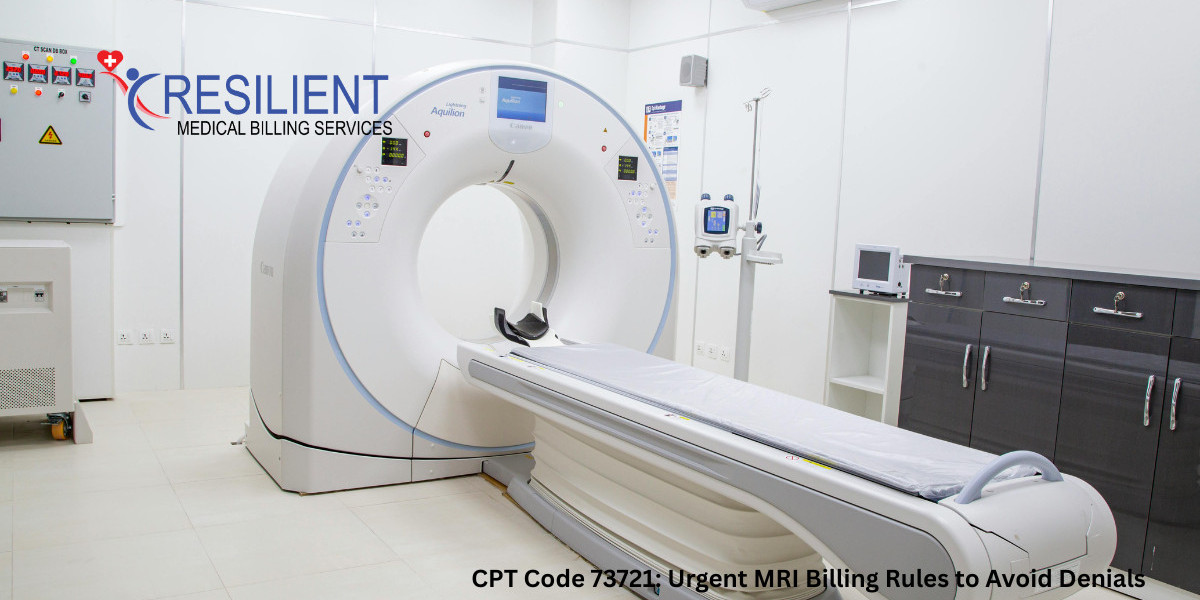

Resilient MBS sees CPT code 73721 denials happen when a lower-extremity joint MRI is billed without enough clinical support, incorrect contrast coding, missing authorization, or weak payer-specific documentation. For busy medical billing professionals, one small coding error can delay payment, trigger rework, and create unnecessary A/R pressure.
Resilient MBS defines CPT 73721 as the code commonly used for MRI of a lower-extremity joint without contrast material, such as the hip, knee, or ankle. Because MRI billing procedures are closely reviewed by payers, billing teams must confirm that the order, report, diagnosis, authorization, and claim all tell the same story.
Resilient MBS wants billing professionals to treat CPT 73721 as more than a simple radiology code. It is a compliance-sensitive claim item where documentation, medical necessity, payer policy, and accurate coding must work together before submission.
What CPT Code 73721 Covers
Resilient MBS explains CPT 73721 as MRI imaging of a lower-extremity joint without contrast. This usually applies when a provider orders a non-contrast MRI to evaluate joint pain, suspected ligament injury, meniscal damage, cartilage concerns, tendon issues, trauma, or other lower-extremity joint conditions.
Resilient MBS reminds billing teams that CPT 73721 should not be used when contrast is administered. If contrast was used, the coding pathway changes, and the claim must match the actual imaging service performed. This is where many medical billing denials begin.
Resilient MBS recommends checking three documents before billing CPT 73721: the physician order, the radiology report, and the authorization approval. If one says “with contrast” and another says “without contrast,” the claim should be stopped and corrected before submission.
Common CPT 73721 Denial Triggers
1. Missing or Invalid Prior Authorization
Resilient MBS often sees CPT 73721 denied when prior authorization is missing, expired, tied to the wrong CPT code, or attached to the wrong imaging site. Payers may approve one MRI service but deny another if the code, diagnosis, location, or date range does not match exactly.
Resilient MBS recommends that billing teams verify authorization before the scan, not after the claim denial arrives. For Texas and Virginia practices handling high imaging volume, this step can prevent avoidable revenue leakage.
2. Weak Medical Necessity Documentation
Resilient MBS warns that CPT 73721 requires medical necessity that supports why the MRI was needed. A vague diagnosis such as “joint pain” may not be enough unless the clinical record explains symptoms, exam findings, failed conservative treatment, trauma history, or suspected internal derangement.
Resilient MBS advises teams to connect the diagnosis code with the provider’s notes and imaging reason. The stronger the clinical story, the stronger the claim.
3. Wrong Contrast Selection
Resilient MBS identifies contrast mismatch as a major denial risk in MRI billing procedures. CPT 73721 is for a non-contrast MRI, so billing it when contrast was used can lead to payer rejection, downcoding, audit exposure, or delayed reimbursement.
Resilient MBS recommends building a coding checklist that separates lower-extremity joint MRI without contrast, with contrast, and without-and-with contrast. This simple workflow can prevent expensive CPT coding compliance mistakes.
4. Incorrect Modifier Use
Resilient MBS reminds billers that modifiers should explain the claim, not rescue a weak claim. Modifier misuse can trigger payer scrutiny, especially when multiple imaging services are billed on the same date or when separate anatomic sites are involved.
Resilient MBS recommends reviewing payer guidance and NCCI edits before adding modifiers. A modifier should be supported by documentation, separate service logic, and payer rules.
5. Billing the Wrong Body Area
Resilient MBS cautions that CPT 73721 applies to lower-extremity joint imaging, not every lower-extremity MRI. A knee, hip, or ankle joint MRI may fit CPT 73721, but a non-joint lower-extremity MRI may require a different code.
Resilient MBS advises billing teams to review the radiology report carefully. The report should identify the actual joint or body region imaged before the claim is finalized.
CPT 73721 Compliance Checklist for Billing Teams
Resilient MBS recommends this quick pre-submission checklist for CPT 73721 claims:
Resilient MBS confirms the order clearly supports MRI of a lower-extremity joint without contrast.
Resilient MBS confirms the radiology report matches the ordered service and CPT code.
Resilient MBS confirms the diagnosis code supports medical necessity.
Resilient MBS confirms prior authorization is valid for the payer, CPT code, location, and date of service.
Resilient MBS confirms contrast was not used.
Resilient MBS confirms modifiers are only added when supported.
Resilient MBS confirms payer-specific LCD, medical policy, or authorization rules were reviewed when required.
Resilient MBS confirms claim notes and attachments are available if the payer requests support.
Why Outsourced Billing Services Must Handle CPT 73721 Carefully
Resilient MBS understands that outsourced billing services are often judged by clean claim rate, denial reduction, and speed of reimbursement. CPT 73721 is exactly the type of code where a strong billing partner can protect the practice from costly rework.
Resilient MBS also knows that teams searching for outsourced mental health billing services may still need broader compliance education across specialties. Whether the claim involves behavioral health coding, orthopedic imaging, radiology billing, or MRI billing procedures, the same principle applies: accurate documentation drives clean reimbursement.
Resilient MBS helps billing professionals think beyond code entry. The goal is not just to submit CPT 73721 faster. The goal is to submit it correctly the first time with payer-ready documentation.
Texas and Virginia Billing Considerations
Resilient MBS encourages Texas and Virginia billing teams to pay close attention to payer mix, authorization vendors, commercial policy differences, Medicare rules, and Medicaid-specific requirements. Imaging claims can vary widely by payer, and local denial patterns should be tracked monthly.
Resilient MBS recommends that practices monitor CPT 73721 denial trends by payer, diagnosis, provider, location, modifier, and authorization issue. This turns denial data into a practical prevention system instead of a repeated administrative burden.
Resilient MBS believes billing teams should treat every denial as a signal. If the same CPT 73721 denial repeats, the issue is usually not one claim. It is often a workflow gap.
How to Reduce CPT 73721 Denials
Resilient MBS recommends creating a front-end MRI billing workflow before claims reach the clearinghouse. This includes eligibility checks, authorization verification, order review, diagnosis validation, and coding review.
Resilient MBS also recommends building specialty-specific denial playbooks. A CPT 73721 playbook should include payer rules, common denial codes, appeal templates, required documentation, and escalation steps for recurring issues.
Resilient MBS emphasizes that denial prevention is faster and cheaper than denial recovery. Once a claim is denied, staff time increases, reimbursement slows down, and the practice loses operational momentum.
When to Appeal a CPT 73721 Denial
Resilient MBS recommends appealing CPT 73721 denials when the documentation supports medical necessity, the authorization was valid, the service matched the order, and the payer denied incorrectly. A strong appeal should include the order, report, clinical notes, authorization proof, and a concise explanation.
Resilient MBS warns against sending generic appeals. Payers need a clean, evidence-based response that directly addresses the denial reason.
Resilient MBS also recommends tracking appeal outcomes. If a payer repeatedly overturns the same denial, your team may have leverage to improve front-end handling or payer communication.
FAQs
What is CPT code 73721 used for?
Resilient MBS explains that CPT code 73721 is used for MRI of a lower-extremity joint without contrast, commonly involving the hip, knee, or ankle.
Can CPT 73721 be billed if contrast is used?
Resilient MBS advises that CPT 73721 should not be used when contrast is administered because the billed code must match the actual MRI service performed.
Why do CPT 73721 claims get denied?
Resilient MBS commonly sees CPT 73721 denials caused by missing authorization, weak medical necessity, incorrect diagnosis coding, contrast mismatch, modifier errors, or payer policy conflicts.
Is prior authorization required for CPT 73721?
Resilient MBS recommends verifying prior authorization for CPT 73721 because many commercial payers require approval before advanced imaging services.
How can billing teams reduce CPT 73721 denials?
Resilient MBS recommends using a pre-submission checklist, validating the order and report, confirming authorization, checking payer policy, and reviewing diagnosis support before claim submission.