
Accounts payable (AP) is one of the most important financial functions in any business. It directly impacts cash flow, vendor relationships, and overall financial accuracy. However, as companies grow, managing invoices, approvals, payments, and compliance internally becomes increasingly complex and time-consuming. This is where accounts payable business process outsourcing (AP BPO) comes in as a strategic solution.
In 2026, more businesses are shifting toward outsourcing AP functions to improve efficiency, reduce costs, and strengthen financial control.
What Is Accounts Payable Business Process Outsourcing?
Accounts payable business process outsourcing refers to the practice of delegating AP tasks to an external service provider. These tasks typically include:
- Invoice processing and verification
- Vendor management and onboarding
- Payment processing and scheduling
- Expense tracking and reconciliation
- Compliance and reporting support
Instead of handling everything in-house, businesses rely on specialized outsourcing partners who use automation tools, skilled teams, and standardized workflows to manage AP operations efficiently.
This allows internal finance teams to focus more on strategic tasks such as budgeting, forecasting, and financial planning.
How Accounts Payable Outsourcing Works
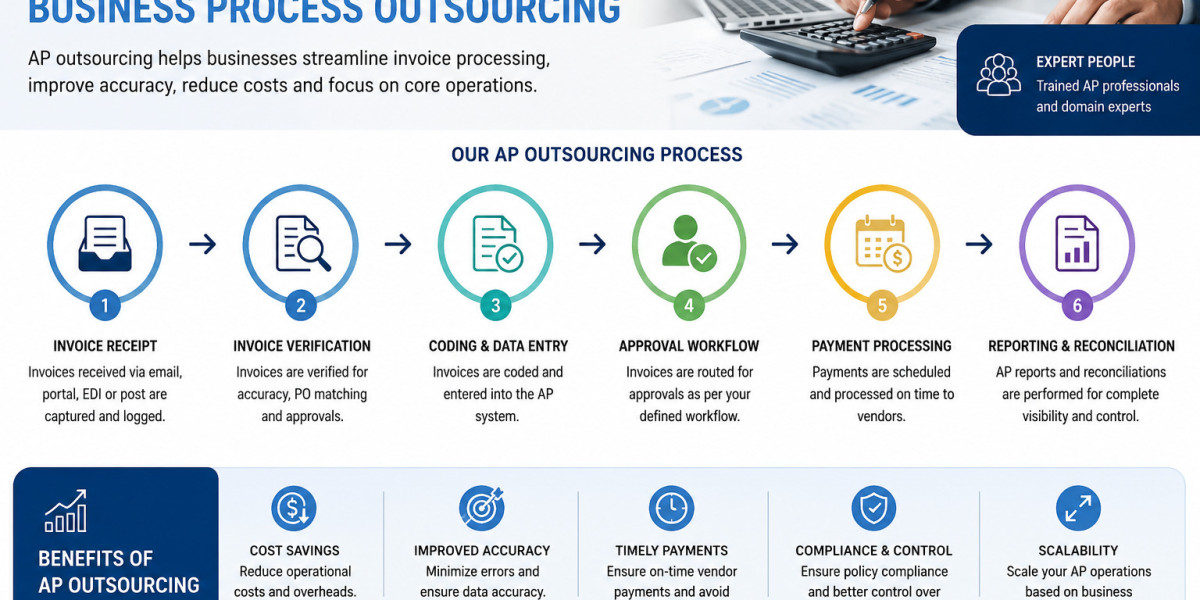
The AP outsourcing process is designed to be seamless and structured. Although it may vary slightly depending on the provider, the typical workflow includes:
1. Invoice Collection and Capture
Invoices are collected from multiple sources such as email, vendor portals, or physical documents. Advanced providers use automation tools like OCR (Optical Character Recognition) to digitize invoice data.
2. Data Entry and Validation
Once captured, invoice data is validated against purchase orders, contracts, and vendor records to ensure accuracy and prevent fraud or duplication.
3. Approval Workflow
Invoices are routed through a predefined approval hierarchy. This ensures that the right stakeholders review and approve payments on time.
4. Payment Processing
After approval, payments are scheduled and processed according to agreed terms. This helps avoid late fees and maintains strong vendor relationships.
5. Reconciliation and Reporting
All transactions are recorded, reconciled, and reported for financial transparency. Businesses receive detailed reports for better decision-making and audit readiness.
Benefits of Accounts Payable Business Process Outsourcing
Outsourcing AP functions provides several strategic advantages for businesses of all sizes.
1. Cost Reduction
Maintaining an in-house AP team involves salaries, infrastructure, training, and software costs. Outsourcing helps reduce these overhead expenses significantly while maintaining high-quality output.
2. Improved Accuracy
Human errors in invoice processing can lead to payment delays or financial discrepancies. Outsourcing providers use automation and standardized processes to improve accuracy and minimize errors.
3. Faster Processing
Automated workflows and dedicated teams ensure invoices are processed quickly. This helps businesses take advantage of early payment discounts and avoid late penalties.
4. Better Cash Flow Management
With real-time visibility into payables, businesses can manage cash flow more effectively. This allows for smarter financial planning and improved liquidity control.
5. Scalability
As businesses grow, invoice volume increases. Outsourced AP services can easily scale without the need to hire and train additional staff.
6. Stronger Vendor Relationships
Timely and accurate payments help build trust with vendors, which can lead to better negotiation terms and long-term partnerships.
Challenges in Traditional Accounts Payable Management
Before outsourcing, many businesses face several AP challenges:
- Manual invoice processing delays
- Duplicate or fraudulent payments
- Lack of visibility into liabilities
- Poor communication with vendors
- Inefficient approval workflows
- High operational costs
These challenges not only slow down financial operations but also increase the risk of compliance issues and financial losses.
Why Businesses Are Outsourcing AP in 2026
The business environment in 2026 is driven by automation, remote operations, and cost optimization. Companies are increasingly adopting AP outsourcing for the following reasons:
Digital Transformation
Businesses are moving away from paper-based and manual accounting systems toward cloud-based automation solutions.
Focus on Core Activities
Outsourcing allows finance teams to focus on strategic decision-making instead of repetitive administrative work.
Global Operations
Companies operating across multiple regions need standardized AP processes to manage different currencies, tax rules, and compliance requirements.
Regulatory Compliance
Outsourcing partners stay updated with changing tax regulations and ensure businesses remain compliant with financial reporting standards.
Key Features to Look for in an AP Outsourcing Partner
Choosing the right provider is critical for success. Businesses should look for:
- Advanced automation tools (OCR, AI-based invoice matching)
- Strong data security and compliance standards
- Transparent reporting systems
- Integration with accounting software (ERP systems)
- Scalable service models
- Experienced finance professionals
A reliable partner ensures smooth transition and long-term operational efficiency.
Future of Accounts Payable Outsourcing
The future of AP outsourcing is closely linked with automation and artificial intelligence. In the coming years, we can expect:
- AI-powered invoice processing and fraud detection
- Real-time financial dashboards
- Fully automated approval workflows
- Predictive cash flow analytics
- Blockchain-based payment verification systems
These advancements will make AP processes faster, more secure, and highly intelligent.
Conclusion
Accounts payable business process outsourcing is no longer just a cost-saving option—it is a strategic necessity for modern businesses. It helps organizations reduce operational burdens, improve financial accuracy, and scale efficiently in a competitive market.
As we move further into 2026, businesses that adopt AP outsourcing will gain a clear advantage in speed, compliance, and financial control. Whether you are a small business or a large enterprise, outsourcing accounts payable can help you streamline operations and focus on what truly matters: growth.