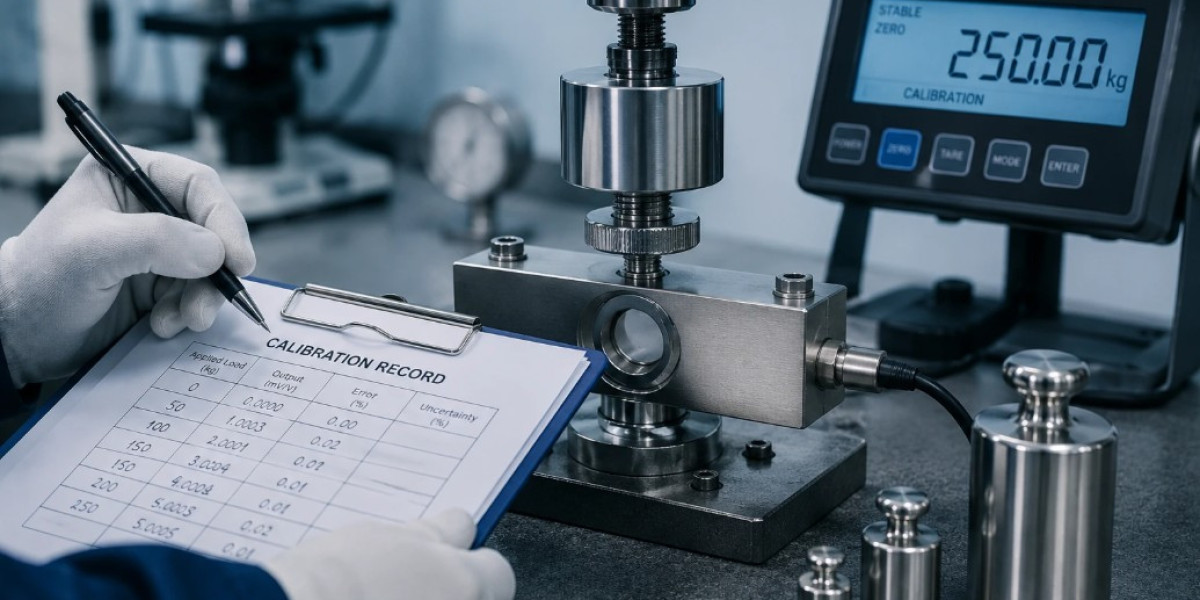

If you work in manufacturing, construction, automotive testing, or any engineering discipline where force must be measured accurately — your work depends on load cells. And load cells, no matter how well-made, drift. Their accuracy degrades silently over time, through every loading cycle, every temperature swing, and every environment they are exposed to.
The only way to know your load cell is still giving you the right answer is to calibrate it — formally, traceably, against a known reference standard. But finding a load cell calibration service near you that is technically rigorous enough to satisfy an ISO auditor, an NABL assessor, or a demanding industrial customer? That is the challenge this blog addresses.
At SR Uniq Measurement Technologies & Consultancy, we calibrate load cells daily — compression types, tension types, S-beam, shear beam, and universal configurations — across a range of 50 N to 3000 kN, using dead weight force machines, in a 23°C ± 2°C climate-controlled laboratory in Ghaziabad, Uttar Pradesh. This is our field. This guide is written from that firsthand experience.
What Is a Load Cell? The Engineering Fundamentals
Before calibration can make sense, the instrument itself must be understood. A load cell is a precision electromechanical force transducer — a device that converts an applied mechanical force into a proportional electrical signal. The working principle, in the vast majority of industrial load cells, is the Wheatstone bridge circuit built from bonded strain gauges.
Here is how the physics works in practice: when a force is applied to the load cell’s machined elastic element — typically a steel or aluminium body — the material deforms by a precise, repeatable amount governed by Hooke’s Law. The strain gauges bonded to this element deform with it, changing their electrical resistance. The four strain gauges arranged in a Wheatstone bridge configuration convert this resistance change into a differential voltage output — typically in millivolts per volt (mV/V) of excitation.
This output voltage is what your indicator, data logger, or PLC reads. The calibration of the load cell is the formal establishment of the precise relationship between applied force and electrical output — verified against a traceable reference standard.
Where Load Cells Are Used
Understanding the range of applications for which load cells provide the primary measurement gives context to why calibration accuracy matters so deeply:
- Manufacturing quality control: Press force monitoring, assembly verification, conveyor tension measurement, packaging line force QC
- Material testing: Universal testing machines (UTMs) for tensile, compressive, and fatigue testing of metals, polymers, composites, and textiles
- Weighing systems: Platform scales, weighbridges, silo load monitoring, and legal metrology applications
- Civil and structural engineering: Pile load testing, anchor bolt pull-out testing, structural bearing load monitoring
- Aerospace and defense: Component structural load testing, thrust measurement, qualification testing rigs
- Automotive testing: Crash test instrumentation, fatigue test rigs, chassis dynamometer force measurement
- Research and academia: Experimental force measurement in universities, government labs, and private R&D facilities
In every one of these applications, the accuracy of the load cell’s output is directly tied to the quality of its last calibration.
What Is Load Cell Calibration? Definition and Purpose
Load cell calibration is the formal, documented process of comparing a load cell’s electrical output at multiple known force levels against a traceable reference standard — and establishing both the accuracy of the instrument and the measurement uncertainty associated with its use.
In simpler engineering terms: you apply a precisely known force to the load cell and record what it says. You do this at multiple points across its range, in both loading directions. You compare the results against the reference, calculate the error at each point, assess the repeatability across multiple cycles, and document everything in a calibration certificate.
The calibration process answers these four fundamental questions about your load cell:
- Sensitivity: What is the actual output per unit of applied force (mV/V per kN)? Has it drifted from the original specification?
- Linearity: Does the output increase proportionally across the full measurement range, or are there non-linear deviations at certain force levels?
- Repeatability: Does the load cell return the same output each time the same force is applied? Inconsistency across cycles indicates mechanical or electrical degradation.
- Uncertainty: What is the total measurement uncertainty of the load cell in its calibrated condition, expressed at 95% confidence? This is the number your quality system and auditors need.