
When faced with a sports injury, chronic back pain, or the need for post-surgical rehabilitation, patients in Dubai often find themselves choosing between conventional methods and emerging technology. Traditional physiotherapy has long been the gold standard for recovery, relying on manual therapy, stretching, and resistance exercises. However, the rise of Prolex Vibration Therapy in Dubai has introduced a high-frequency alternative that claims to achieve results in a fraction of the time. The question for many isn't just about which is "better," but which approach aligns with their specific recovery goals and lifestyle.
At Tajmeels Clinic, we observe that these two modalities are not necessarily rivals; rather, they are different tools in a comprehensive recovery toolkit. Understanding the strengths of each allows for a more strategic approach to healing.
The Traditional Physiotherapy Approach
Traditional physiotherapy is a "hands-on" and active process. It focuses on isolating specific muscle groups and correcting biomechanical imbalances through conscious movement.
Manual Mastery and Targeted Exercise
We observe that the strength of traditional physiotherapy lies in its specificity. A therapist can manually mobilize a joint or guide a patient through a very specific corrective stretch. This is essential for retraining the brain to move a limb after a severe injury. However, traditional therapy is often time-consuming, requiring 45–60 minutes of active physical effort from the patient, which can be challenging for those with low stamina or acute pain.
The Prolex Vibration Therapy Advantage
In contrast, Prolex Vibration Therapy in Dubai is primarily a neuromuscular and systemic intervention.
Automated Muscle Recruitment
Can Prolex achieve more than manual exercise?
We observe that during a 15-minute session on the Prolex platform, the body undergoes thousands of involuntary muscle contractions. While a traditional gym or physio session might engage 40% to 60% of muscle fibers, we observe that the mechanical oscillations of Prolex can engage up to 90% to 95% of the muscular system simultaneously. This "force multiplier" effect makes it an incredibly efficient tool for building baseline stability and increasing circulation without the fatigue associated with a long workout.
Side-by-Side Comparison: Efficiency and Experience
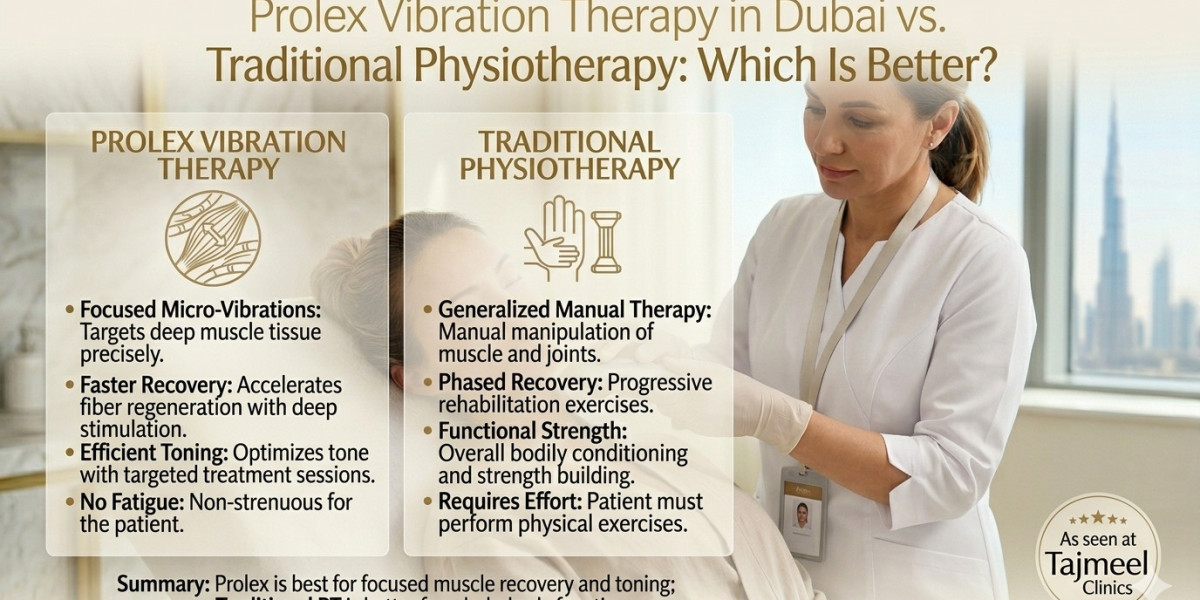
Mechanism of Action: Traditional physio uses conscious, voluntary movement; Prolex uses involuntary, reflexive muscle contractions triggered by high-frequency vibration.
Time Commitment: A standard physio session takes 60 minutes; a highly effective Prolex session takes only 10–20 minutes.
Pain Management: Traditional physio can sometimes be uncomfortable as it pushes the limits of a joint; Prolex provides a "gate control" analgesic effect that often dulls pain during the session.
Impact on Joints: Traditional exercise involves gravity and load; Prolex provides a weight-bearing stimulus with virtually zero impact on the joints.
Patient Effort: Physio requires active participation; Prolex is a "passive-active" therapy where the machine does much of the work while the patient maintains a specific posture.
When to Choose Which Modality?
At Tajmeels Clinic, we observe that the "best" choice depends on where you are in your recovery journey.
Choosing Traditional Physiotherapy
We recommend traditional methods when a patient needs to relearn a specific skill (like walking after a stroke) or when a joint requires deep manual mobilization that only a therapist's hands can provide. It is also the preferred choice for those who need highly specific, isolated muscle strengthening.
Choosing Prolex Vibration Therapy in Dubai
We observe that Prolex is the superior choice for:
Rapid Pain Relief: Patients seeking an immediate "reset" for chronic back or neck stiffness.
Bone Density Support: Seniors or those with osteoporosis who cannot perform heavy lifting.
Metabolic and Circulatory Boost: Those with "heavy legs," swelling, or a slow metabolism.
Time-Poor Professionals: Busy residents in Dubai who need a recovery "express" session during a work break.
The "Hybrid" Strategy: Why Not Both?
Based on our clinical observations at Tajmeels Clinic, the most successful patients are those who combine the two. We often use Prolex Vibration Therapy in Dubai as a "warm-up" to traditional physiotherapy. By vibrating the muscles first, we increase tissue temperature and neural drive, making the subsequent manual stretches and exercises much more effective and less painful.
Social Proof: Patient Recovery Journeys
"I spent months doing traditional physio for my knee, and progress was slow. My therapist added 10 minutes of Prolex Vibration Therapy in Dubai at the start of every session, and my recovery accelerated immediately. My range of motion improved faster than ever." — Karim
"I love the Prolex sessions because they fit into my busy schedule. I do traditional physio on the weekends, but my mid-week Prolex session at Tajmeels Clinic keeps my back pain from flaring up during the work week." — Nadia
Why Choose Tajmeels Clinic?
At Tajmeels Clinic, we don't believe in "tech-only" or "manual-only" solutions. We observe that your body is a complex system that requires a multi-dimensional approach. Our practitioners are trained in both traditional physical therapy and the advanced protocols of Prolex Vibration Therapy in Dubai. We assess your condition and design a hybrid plan that utilizes the efficiency of Prolex and the precision of traditional manual therapy. By choosing Tajmeels, you are choosing a balanced, science-driven path to optimal health.
FAQs
Is Prolex more expensive than a traditional physiotherapy session?
We observe that because Prolex sessions are shorter, they are often more cost-effective per session. However, at Tajmeels Clinic, we often bundle them to ensure you get the best value for your comprehensive recovery plan.
Can I do Prolex if my traditional physio said "no heavy lifting"?
Yes! We observe that Prolex provides the benefits of weight-bearing exercise (strengthening bones and muscles) without the actual "load" or "impact" of lifting weights. This makes it a perfect bridge for those in the early stages of rehab.
Does Prolex replace the need for stretching?
Not entirely. While we observe that vibration therapy improves fascial elasticity, it works best when combined with the specific, targeted stretches prescribed in traditional physiotherapy.
Can I do Prolex on the same day as my physio session?
Absolutely. We observe that doing them back-to-back is actually the "gold standard" for recovery. The vibration primes the muscles, making the manual work more effective.
Which is better for weight loss?
We observe that Prolex Vibration Therapy in Dubai is superior for increasing metabolic rate and muscle fiber recruitment compared to a standard stretching-based physio session.
Is Prolex safe for people who find traditional exercise too painful?
Yes. We observe that for patients with fibromyalgia or chronic fatigue, traditional physio can be too taxing. Prolex allows them to receive the benefits of movement without the exhaustive effort.