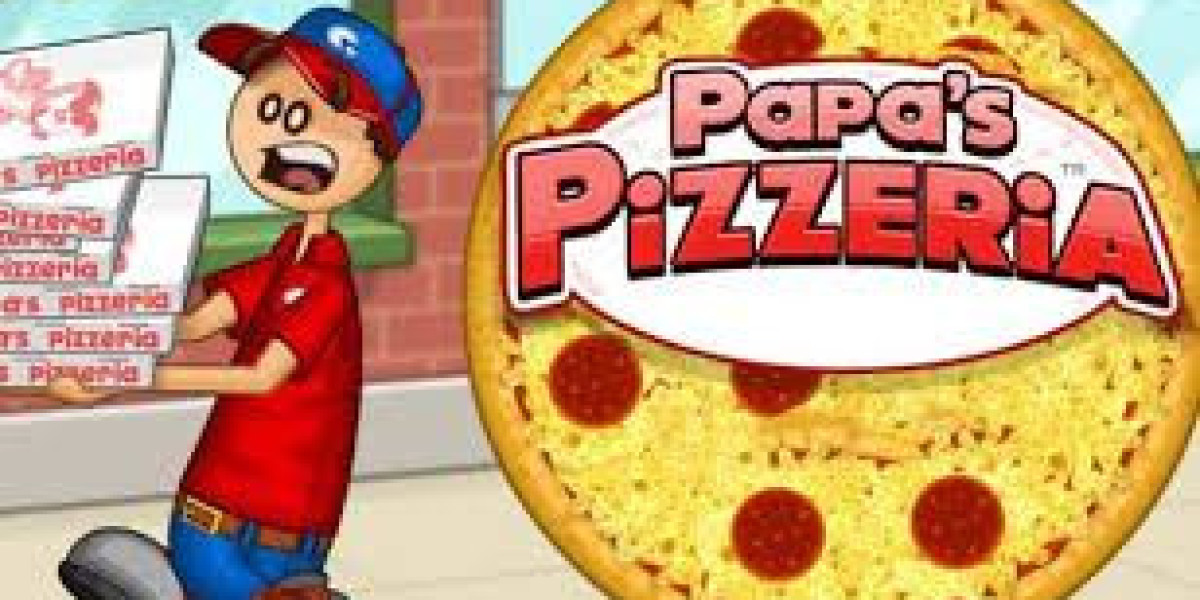

There’s something almost suspicious about how quickly a simple game about making pizzas can take over your attention.
No sprawling open world. No cinematic story. Just a counter, a list of orders, and a steady stream of increasingly picky customers. And yet, hours disappear. You tell yourself you’ll finish “just one more day,” and suddenly you’re deep into a rhythm of dough stretching, topping placement, and oven timing like it actually matters.
Somewhere in that loop, Papa’s Pizzeria stops being a casual distraction and becomes a kind of low-stakes obsession.
The Comfort of Repetition
At first glance, the gameplay loop is almost aggressively simple. Take an order. Build the pizza. Bake it. Slice it. Serve it. Repeat.
But repetition here isn’t laziness—it’s design. Each step is just tactile enough to feel engaging. You drag toppings into place and instinctively start spacing them evenly, even before the game penalizes you for sloppy work. You learn how long “too long” in the oven looks like. You begin to anticipate the rhythm of incoming customers.
What’s interesting is how quickly the brain latches onto this loop. There’s no need to relearn controls or think too hard about what comes next. That mental ease creates space for something else: refinement.
You’re not just making pizzas—you’re making better pizzas than you did five minutes ago.
And that’s where the hook sets in.
When Simple Tasks Become Personal Standards
The game never explicitly tells you to care. It gives you a score, sure, and customers react based on how well you followed their orders. But the real pressure doesn’t come from the game—it comes from you.
You start noticing things. A pepperoni slightly off-center. A cut that isn’t perfectly even. A pizza that sat in the oven just a few seconds longer than it should have.
None of these are catastrophic mistakes. But they feel like they matter.
That’s the strange psychological shift these games create. The objective isn’t just to complete tasks—it’s to meet a standard that slowly becomes internalized. Over time, “good enough” stops feeling good enough.
You want clean lines. Symmetry. Precision.
And when you hit it—when everything lines up perfectly—it’s quietly satisfying in a way that’s hard to explain to someone who hasn’t played.
The Stress of Too Many Orders (and Why It Works)
Of course, the game doesn’t let you sit in that comfort zone for long.
As more customers arrive, the pressure builds. Orders stack up. You’ve got one pizza in the oven, another halfway topped, and a third customer tapping their foot at the counter.
This is where Papa’s Pizzeria shifts from relaxing to mildly stressful—but in a controlled, almost enjoyable way.
You start making small decisions constantly:
- Do you finish topping this pizza before taking the next order?
- Should you pull the pizza out early to avoid burning it, even if it’s not fully baked?
- Can you afford to let a customer wait a little longer?
None of these decisions are dramatic on their own, but together they create a steady cognitive load. You’re juggling priorities, managing time, and trying not to let anything slip.
And when it inevitably does slip—when you forget a pizza in the oven or misread an order—it doesn’t feel unfair. It feels like you dropped the ball.
That sense of responsibility is what keeps you engaged. The game isn’t punishing you arbitrarily. It’s reflecting your own attention (or lack of it) back at you.
The Satisfaction of Getting Into a Flow
There’s a moment, somewhere after the early chaos but before things get overwhelming, where everything clicks.
You stop hesitating. You take orders quickly, build pizzas efficiently, and manage the oven almost without thinking. Your hands (or mouse) seem to move on their own. You’re not reacting anymore—you’re anticipating.
This is the flow state these games quietly aim for.
It’s not flashy. There’s no dramatic music cue or visual indicator. But you feel it. Time compresses. Distractions fade. You’re just… working, but in a way that feels smooth and controlled.
And because the tasks are so grounded—placing toppings, watching timers—the flow feels tangible. You can see your competence in every well-made pizza.
That’s a big part of the appeal. Progress isn’t abstract. It’s visible, immediate, and repeatable.
Nostalgia for Browser Games That Knew Their Limits
For a lot of players, Papa’s Pizzeria isn’t just a game—it’s a memory.
It belongs to a specific era of browser games, where you’d load something up between classes or during a quiet evening and get completely absorbed without realizing it. No downloads. No updates. Just click and play.
Those games didn’t try to be everything. They focused on one idea and executed it well.
There’s a reason people still look for experiences like this, whether through emulators or modern recreations. That simplicity feels refreshing now, especially compared to games that demand constant attention, progression systems, and long-term commitment.
If anything, Papa’s Pizzeria highlights how much can be done with very little—as long as the core loop feels good.
It’s the same reason people revisit titles discussed in [our breakdown of classic browser game loops] or reflect on [why small-scale games still stick with us years later]. The scope is small, but the engagement runs deep.
How Tiny Systems Shape Player Behavior
One of the most interesting things about games like this is how they quietly train you.
At first, you might place toppings randomly. Cut pizzas unevenly. Ignore small details because they don’t seem important.
But the game nudges you. Scores improve when you’re precise. Customers react better when you follow their preferences closely. Over time, you adjust.
You start aiming for consistency. You develop habits:
- Placing toppings in evenly spaced patterns
- Checking the oven more frequently
- Taking orders in a specific sequence
None of this is forced. It emerges naturally from the system.
That’s what makes it effective. You’re not being told how to play—you’re learning what works through feedback and gradually optimizing your behavior.
And once those habits form, they stick. Even if you step away and come back later, your hands remember what to do.
The Low Stakes That Make It Hard to Quit
Despite the pressure and occasional mistakes, the stakes in Papa’s Pizzeria remain relatively low.
You’re not losing hours of progress. You’re not facing harsh penalties. A bad pizza might hurt your score, but the game moves on. There’s always another day, another order, another chance to do it better.
That low-stakes environment is part of what makes the game so hard to put down.
Failure doesn’t feel punishing—it feels corrective. You notice what went wrong and immediately get an opportunity to fix it. That tight feedback loop keeps you engaged without creating frustration.
It’s a delicate balance. Too easy, and the game becomes boring. Too punishing, and it becomes stressful in the wrong way.
Papa’s Pizzeria sits somewhere in the middle, where mistakes matter just enough to keep you paying attention.
Why It Still Lingers
Long after you stop playing, certain details stick with you.
The rhythm of taking orders. The visual of toppings arranged just right. The quiet satisfaction of sending out a perfect pizza.
It’s not the kind of game people usually call “memorable,” but it lingers anyway. Not because of story or spectacle, but because of how it felt to play.