
Clients Notice More Than Your Work
Here's an uncomfortable truth that doesn't get discussed enough in creative industries: clients are forming opinions about you before you play them a single track, show them a single frame, or deliver a single line of copy.
They're forming opinions when they walk into your studio.
The state of your workspace communicates things about you that your portfolio can't — how organized you are, how seriously you take your craft, how much you've invested in doing this right. A chaotic, cobbled-together studio with mismatched furniture and visible cable spaghetti reads as amateur, even if the work produced in it is genuinely excellent. A purposeful, well-designed space reads as professional before you've said a word.
For creative professionals across the US who compete on reputation and referrals, that first impression is worth investing in. And the place that impression starts is the physical environment — specifically, the furniture that defines it.
What a Studio Space Actually Communicates
The psychology of professional environments
There's real research behind why physical environment affects professional perception, but you don't need to cite studies to understand it intuitively. Think about the service providers you trust most. Think about the offices, studios, and spaces you've walked into that made you feel like you were in good hands before the conversation started.
Those spaces share something: they feel intentional. Not necessarily expensive — intentional. Every element seems like it was chosen deliberately, placed deliberately, and maintained deliberately. That intentionality signals competence and care in a way that's hard to articulate but impossible to miss.
Generic furniture works against that impression. It's not intentional — it's default. It says "I bought what was available" rather than "I designed this for what I do." For a creative professional whose brand depends on the perception that they make considered, skilled choices, that's a problem.
The workspace as an extension of your brand
The most successful creative studios in the US treat the physical workspace as an extension of the brand, not as infrastructure separate from it. The aesthetic, the organization, the quality of the materials — it all reflects the standards the studio holds in its actual work.
When a client visits and the space feels coherent, considered, and purpose-built, it reinforces everything your portfolio says about you. When the space feels improvised, it creates a subtle dissonance that's hard to overcome, even with excellent work.
Custom studio office furniture is one of the most direct ways to close that gap — to make the physical environment say the same things about your professional standards that your work does.
Designing for the Way You Actually Work
The zones of a functional creative studio
Good studio design starts with honest observation of how work actually flows through the space. Most professional studios, regardless of discipline, have at least three distinct functional zones: the primary production zone where the core work happens, a secondary reference or review zone for stepping back and evaluating, and a client or collaboration zone where you share work and have conversations.
Each zone has different ergonomic requirements, different storage needs, and different spatial logic. Designing all three with off-the-shelf furniture almost always means compromising at least two of them to make one work reasonably well.
With custom studio office furniture built around your specific workflow, each zone can be optimized independently while functioning as part of a coherent visual and spatial whole. The primary production surface gets the depth, height, and integrated infrastructure it needs. The review zone has the right seating arrangement and screen positioning. The client zone feels welcoming and communicates professionalism.
The desk as the functional centerpiece
In most creative studios, everything in the room organizes around the primary work surface. Get this right and the rest of the room has a logical anchor. Get it wrong and you're fighting the space every day.
A custom studio office furniture solution treats the desk not as a product category but as a design problem — one with specific dimensions, specific functional requirements, specific integration needs, and a specific aesthetic context to fit within.
The depth matters: too shallow and your monitors are at the wrong distance; too deep and you're reaching uncomfortably for your keyboard. The width matters: determined by your specific gear layout, not by a standard product dimension. The height matters: calibrated to your body and your chair, not to a standard ergonomic average. The cable management matters: designed in from the start, not added as an afterthought with adhesive clips and hope.
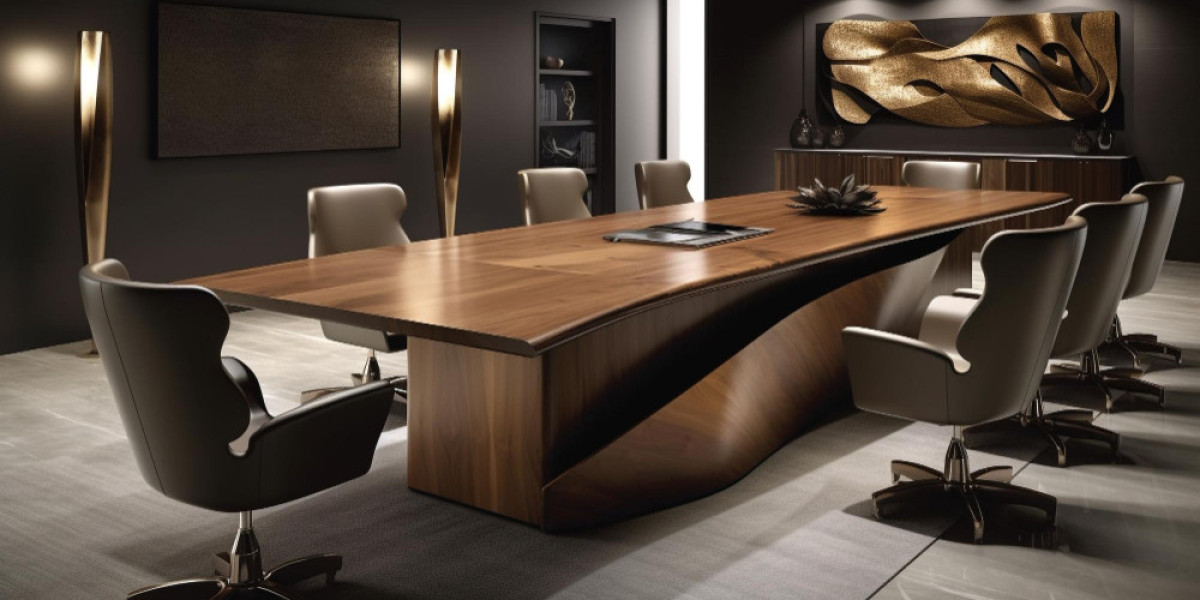
A Custom office desk built to these specifications becomes a piece of professional infrastructure, not just a surface to put things on.
Storage Systems That Work With Your Brain
Visible organization as a professional signal
The way a studio is organized tells clients and collaborators something about how you manage complex work. A well-organized studio says: I have systems, I know where things are, I'm in control of my process. A disorganized one says the opposite, regardless of the quality of the work being produced.
The challenge is that good organization requires storage that was designed around what's being stored. Generic shelving holds things, but it doesn't organize them. True functional organization comes from storage with the right dimensions for the right items — drives, media, reference materials, peripheral gear — in the right positions relative to how they're used.
Custom office furniture systems designed for your specific studio include storage that was thought through as part of the workflow design, not added later to address overflow. The result is a space that maintains its organization naturally because the storage makes the right behavior the easy behavior.
Integration with technology infrastructure
Modern creative studios are technology-dense environments. Power, signal, data cables — they run everywhere, and managing them is one of the perennial challenges of studio design. Custom furniture addresses this at the design level: cable runs are planned, cutouts are precisely placed, cable trays are integrated, power distribution is built in rather than bolted on.
The practical result is a studio where cable management isn't a constant battle. Everything runs cleanly, access is maintained for the connections that need to be changed, and the visual environment stays clean. For client-facing studios, this is a meaningful professional differentiator.
Making the Investment Decision
Phasing for budget reality
Custom studio furniture doesn't have to happen all at once. A practical approach for many US creative professionals is to phase the investment: start with the highest-impact piece — almost always the primary work surface and immediate surrounding infrastructure — and add the remaining elements over subsequent cycles.
Done this way, each phase is designed as part of the complete system, so nothing you buy early becomes incompatible with what comes later. You're investing incrementally in a coherent whole rather than accumulating pieces that may not work together.
Finding the right maker for your context
The custom furniture market in the US is diverse: local craftspeople who specialize in residential work, studio furniture specialists who focus exclusively on creative environments, commercial millwork firms that handle large-scale commercial fit-outs, and hybrid makers who work across all of these.
For creative studio applications, experience with the specific requirements of professional creative spaces matters more than general craftsmanship reputation. A furniture maker who understands monitor positioning, equipment clearances, cable management requirements, and acoustic considerations is a fundamentally different partner than one who doesn't — even if both produce beautifully finished work.
The studios that stand out in the US creative industry aren't an accident. They're designed with intention, built with care, and equipped with furniture that was made for the work being done in them. If your space isn't saying what you want it to say, it's time to change the conversation. Talk to a custom studio furniture specialist and start building the space your work deserves.