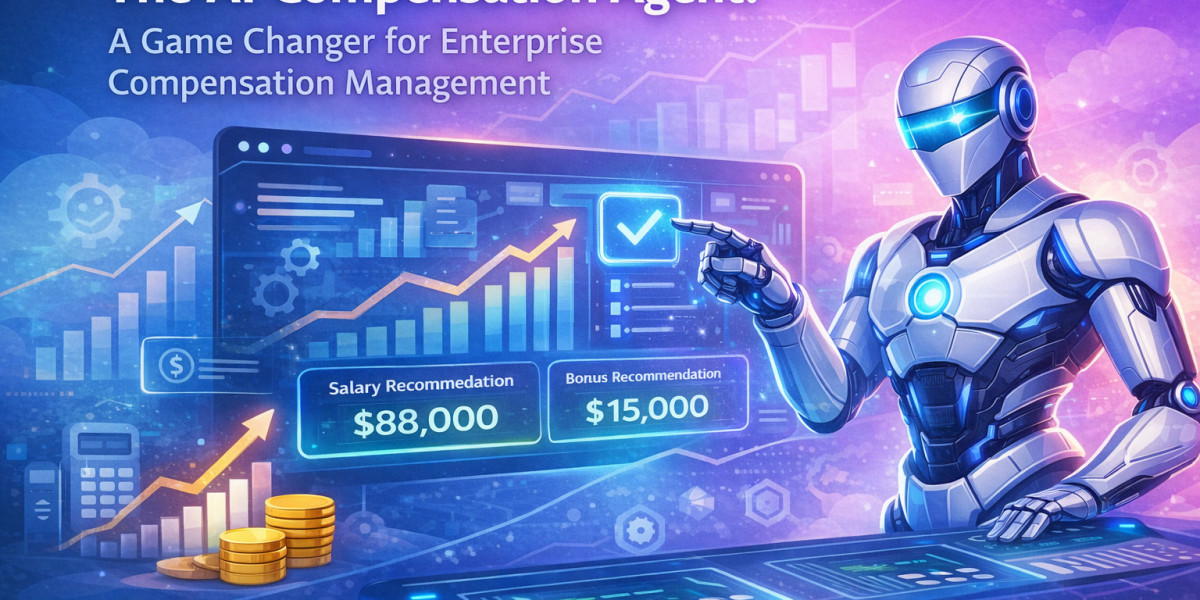

Compensation decisions are among the most sensitive and financially significant actions an enterprise makes. A single merit cycle can impact millions in payroll costs, employee morale, retention, and long-term financial planning. Yet many organizations still rely on spreadsheets, disconnected tools, and manual approvals to manage compensation cycles.
An AI Compensation Agent changes that model entirely. Instead of simply providing reports or dashboards, it actively supports, guides, and automates compensation decisions across the enterprise.
What Is an AI Compensation Agent?
An AI Compensation Agent is an intelligent system designed to assist HR and finance teams in managing salary reviews, merit increases, bonus allocations, and budget controls. Unlike traditional compensation software that only visualizes data, an AI agent analyzes inputs, applies company policies, and recommends optimized outcomes.
It functions as a decision-support layer that helps enterprises:
Simulate compensation scenarios
Allocate budgets across departments
Enforce pay guidelines automatically
Flag inconsistencies or policy violations
Improve pay equity oversight
This approach reduces manual effort while increasing accuracy and transparency.
Why Traditional Compensation Planning Falls Short
Large organizations often struggle with:
Spreadsheet-heavy workflows
Manual approval chains
Inconsistent policy enforcement
Delayed budget visibility
Limited scenario modeling
These inefficiencies increase risk. Over-allocating budgets, approving out-of-band salary increases, or missing equity gaps can create financial and legal challenges.
An AI-driven system addresses these risks by integrating automation and intelligence directly into the compensation workflow.
How an AI Compensation Agent Works
An AI Compensation Agent operates in structured steps:
1. Data Aggregation
It consolidates salary bands, performance ratings, market benchmarks, and budget limits into one system.
2. Policy Enforcement
The agent automatically applies internal guidelines, such as salary band ranges or merit caps, during planning.
3. Scenario Modeling
Teams can simulate “what-if” scenarios before final approvals, understanding financial impact in real time.
4. Intelligent Recommendations
Based on performance data and budget constraints, the system suggests merit increases and bonus distributions.
5. Approval Workflow Integration
Recommendations move through structured approval chains, keeping HR and finance aligned.
This creates a seamless and auditable compensation cycle.
Benefits for HR Teams
HR leaders gain:
Faster compensation cycles
Reduced administrative burden
Consistent policy application
Clear documentation for decision justification
Stronger pay equity oversight
Instead of managing spreadsheets, HR can focus on strategy and employee experience.
Benefits for Finance Teams
Finance stakeholders benefit from:
Real-time budget tracking
Department-level allocation visibility
Controlled payroll growth
Accurate forecasting models
Reduced risk of over-spend
Compensation becomes financially controlled rather than reactive.
Enterprise-Ready Intelligence
For multinational organizations, complexity increases. Multi-currency planning, global workforce distribution, and varied compensation structures require scalable systems.
An AI Compensation Agent supports:
Global compensation alignment
Regional policy differences
Structured approval governance
Enterprise-level data security
This ensures consistency without sacrificing flexibility.
Moving Beyond Static Compensation Software
Traditional compensation tools often focus on reporting and benchmarking. While data is valuable, decision-making at scale requires automation.
Modern enterprises are shifting from:
Data visibility → Intelligent execution
An AI Compensation Agent represents that evolution. It bridges HR and finance, integrates policy logic, and transforms compensation cycles into structured, efficient processes.
The Future of Compensation Management
Compensation will continue to grow more strategic as organizations compete for talent while managing costs responsibly. Enterprises need systems that are:
Intelligent
Policy-aware
Financially aligned
Scalable
AI-driven compensation management is no longer experimental. It is becoming the operational standard for large organizations.