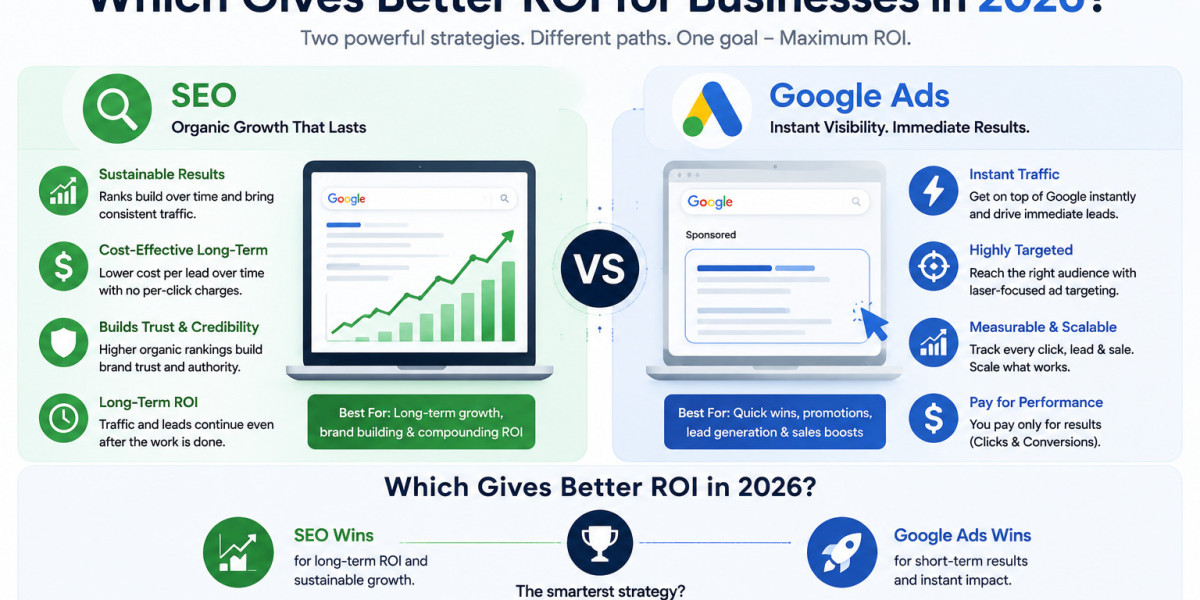

SEO vs Google Ads: Which Gives Better ROI for Businesses in 2026?
Businesses today have more digital marketing options than ever before, but one question still comes up frequently:
Should businesses invest in SEO or Google Ads?
Both strategies help companies improve online visibility, attract customers, and generate leads. However, they work in very different ways and offer different types of returns.
Some businesses prefer SEO because it creates long-term organic traffic. Others choose Google Ads because it can generate immediate leads and faster visibility.
In reality, the better option depends on:
- Business goals
- Budget
- Competition
- Industry
- Growth timeline
Understanding the strengths and limitations of both SEO and Google Ads can help businesses make smarter marketing decisions in 2026.
What Is SEO?
SEO, or search engine optimization, is the process of improving a website’s visibility in organic search results.
SEO involves:
- Content optimization
- Keyword targeting
- Link building
- Technical improvements
- User experience optimization
- Local SEO strategies
The goal is to help websites rank naturally on search engines without paying for clicks.
Strong SEO can generate consistent traffic over time and reduce dependency on paid advertising.
What Is Google Ads?
Google Ads is a paid advertising platform that allows businesses to appear at the top of search results instantly.
Businesses bid on keywords related to their products or services.
When users search those keywords, ads may appear above organic search results.
Google Ads offers:
- Immediate visibility
- Targeted advertising
- Measurable performance
- Fast lead generation
Advertisers pay when users click on their ads, commonly known as Pay-Per-Click advertising.
SEO Provides Long-Term Value
One of the biggest advantages of SEO is long-term sustainability.
Once a website achieves strong rankings, it can continue generating traffic without paying for every click.
SEO helps businesses:
- Build authority
- Increase trust
- Generate recurring traffic
- Improve brand visibility
Although SEO takes time, the long-term return on investment can be very strong.
Businesses with high-ranking content often continue receiving traffic for months or even years.
Google Ads Delivers Faster Results
Google Ads works much faster than SEO.
Businesses can launch campaigns and start receiving traffic within hours.
This makes Google Ads useful for:
- New businesses
- Product launches
- Seasonal promotions
- Quick lead generation
- Competitive industries
Unlike SEO, paid ads provide immediate visibility at the top of search results.
For businesses needing fast customer acquisition, Google Ads often becomes the preferred option.
SEO Builds Trust More Effectively
Many users trust organic search results more than advertisements.
Websites ranking naturally often appear:
- More credible
- More authoritative
- More trustworthy
Strong organic rankings help businesses build brand reputation over time.
Users often associate top organic positions with expertise and reliability.
This trust factor can improve:
- Click-through rates
- Brand perception
- Customer confidence
Google Ads Offers Better Targeting
Google Ads provides advanced targeting options that SEO cannot fully control.
Businesses can target users based on:
- Location
- Device
- Search intent
- Time of day
- Demographics
- Audience behavior
This precision allows businesses to reach highly relevant audiences quickly.
For local businesses or niche services, advanced targeting can improve lead quality significantly.
SEO Traffic Is More Cost Efficient Long-Term
SEO usually requires:
- Content creation
- Website optimization
- Technical improvements
- Link building
Although there are upfront costs, businesses do not pay for each visitor individually.
Over time, SEO traffic often becomes more cost efficient compared to ongoing ad spending.
Businesses with strong SEO foundations may continue receiving leads even during periods with lower marketing budgets.
Google Ads Can Become Expensive
One disadvantage of Google Ads is rising advertising costs.
Highly competitive industries often experience:
- Expensive keywords
- Higher cost per click
- Increased competition
Once businesses stop paying for ads, traffic usually stops immediately.
This makes Google Ads highly effective for short-term growth but potentially expensive over long periods without proper optimization.
SEO Takes Patience
SEO is not a quick process.
Ranking improvements can take:
- Several months
- Ongoing optimization
- Consistent content publishing
Many businesses become frustrated because SEO results are slower compared to paid advertising.
However, long-term SEO growth often creates stronger sustainability.
Patience and consistency are essential for SEO success.
Google Ads Helps Businesses Test Faster
Google Ads allows businesses to test:
- Keywords
- Offers
- Landing pages
- Audience behavior
very quickly.
This data helps businesses identify:
- High-converting services
- Profitable keywords
- Effective messaging
Businesses often use Google Ads insights to improve broader marketing strategies.
SEO Supports Brand Authority
Publishing valuable content helps businesses establish authority within their industries.
SEO-driven content such as:
- Guides
- Tutorials
- Industry insights
- Educational blogs
can position businesses as experts.
Authority-building often improves:
- Brand recognition
- Customer trust
- Organic visibility
This long-term brand value is difficult to achieve through ads alone.
Google Ads Is Better for Immediate Leads
Businesses needing fast leads often benefit more from Google Ads.
For example:
- Emergency services
- Local businesses
- New agencies
- Time-sensitive offers
can generate inquiries almost immediately after launching campaigns.
Google Ads works especially well for users with strong buying intent.
SEO Improves Website Quality
SEO often forces businesses to improve their websites.
Optimization usually includes:
- Better page speed
- Mobile responsiveness
- Improved content
- Better navigation
- User experience improvements
These changes benefit both rankings and customer experience.
SEO improvements often increase overall website quality over time.
Combining SEO and Google Ads Works Best
In many cases, businesses achieve the best results by combining both strategies.
SEO provides:
- Long-term traffic
- Brand authority
- Sustainable growth
Google Ads provides:
- Immediate leads
- Fast visibility
- Quick testing opportunities
Businesses using both strategies often dominate search results more effectively.
Many brands partner with a professional digital marketing company in kolkata to build integrated SEO and Google Ads strategies that improve online visibility, generate targeted leads, and maximize long-term marketing ROI.
Local Businesses Benefit from Both
Local businesses often see strong results when combining:
- Local SEO
- Google Maps optimization
- Google Ads campaigns
This approach improves visibility across:
- Organic search results
- Paid advertisements
- Local map listings
Appearing in multiple search positions increases trust and click-through rates.
AI Is Changing Both SEO and Google Ads
Artificial Intelligence is transforming digital marketing rapidly.
AI now influences:
- Search rankings
- Ad targeting
- User behavior analysis
- Automation
- Content optimization
Businesses must adapt to:
- Smarter algorithms
- Personalized experiences
- AI-driven search behavior
Both SEO and Google Ads are becoming increasingly data-driven.
Which Strategy Gives Better ROI?
The answer depends on business goals.
SEO usually provides:
- Better long-term ROI
- Sustainable traffic
- Lower long-term acquisition costs
Google Ads usually provides:
- Faster ROI
- Immediate leads
- Quick visibility
Businesses looking for immediate growth may prefer Google Ads initially.
Businesses focused on long-term stability often benefit more from SEO.
However, combining both usually creates the strongest overall marketing performance.
Common Mistakes Businesses Make
Some businesses:
- Depend only on paid ads
- Ignore SEO completely
- Expect SEO results too quickly
- Run unoptimized Google Ads campaigns
Balanced strategies usually perform better than relying entirely on one channel.
The Future of Digital Marketing
In 2026, successful businesses are focusing on:
- Search intent
- User experience
- High-quality content
- AI-assisted optimization
- Data-driven advertising
SEO and Google Ads are evolving together rather than competing directly.
Businesses that adapt early to changing digital trends will maintain stronger online visibility.
Conclusion
SEO and Google Ads both offer valuable advantages for businesses in 2026.
SEO builds long-term authority, organic traffic, and sustainable growth, while Google Ads provides immediate visibility and faster lead generation.
Rather than choosing one over the other, many businesses achieve the best results by combining both strategies strategically.
The ideal approach depends on business goals, competition, budget, and growth timeline.
Companies that invest in balanced digital marketing strategies are more likely to build stronger visibility, attract qualified customers, and achieve long-term success online.